TIP 2.0 | Trauma-Informed Professional Certificate Program
How You Show up Changes the Experience of Care
Bridging principles to presence
Deepen your capacity to recognize distress, respond with intention, and create conditions where dignity, connection, and trust can grow.
TIP 2.0 brings science, reflection, and relational practice together for clinicians, educators, and leaders ready to carry trauma-informed care into everyday encounters—and the systems that shape them.
Care happens within relationships. Relationships exist within systems.

The experience of care is shaped by what happens between and around us: our presence, our decisions, our environments, and the conditions in which we work.
TIP helps you notice those influences and act within your sphere of responsibility—with greater clarity, courage, and care.
A Relational Way of Seeing. A Practical Way Forward.

Relational Constellation Model
See the relationships and conditions shaping care.

BUFFER
Cultivate the capacity for relational presence.

Relational Pathway
Bridge principles, presence, practice, and experience.
Principles → Presence → Practice → Experience
Explore the Relational Constellation Model
The Relational Constellation Model
Seeing the person. Holding the whole.
Every experience of care unfolds within a constellation of relationships. In the NICU, the infant, family, and clinician meet within conditions shaped by the team, the organization, the community, and the wider world. Those conditions influence what feels possible: connection, participation, rest, trust, and responsive care. The Relational Constellation Model invites us to widen our attention. Alongside asking, “What care does this person need?” we ask, “What relationships and surrounding conditions are shaping their experience?”
A moment in practice
A parent is quiet during rounds. Before assuming they have no questions, we become curious. Have we made room for their voice? Is the language accessible? Are they exhausted, uncertain, or carrying an earlier experience of being dismissed? That wider view can change our response—and reveal where the team or system needs to change, too.
Within TIP 2.0
This relational perspective helps connect self-awareness, advocacy, and leadership. We explore how our presence matters alongside the conditions that support or constrain caring well.
An invitation to notice: What comes into view when you look beyond the immediate task?

Explore the BUFFER Framework
The BUFFER Framework
Cultivating the capacities that carry care.
Knowing our values matters. Bringing them into an encounter takes practice—especially when time is short, emotions are strong, or uncertainty fills the room.
BUFFER offers six interconnected relational capacities to help us carry trauma-informed principles into how we show up:
Belonging: Make room for connection and participation.
Understanding: Approach another’s experience with curiosity.
Forgiveness: Extend grace and support repair while preserving accountability.
Frameworks: Draw on shared knowledge and guiding principles.
Equanimity: Cultivate a steady, responsive presence.
Respect: Honor dignity, voice, and choice.
Like leaves on a shared stem, these capacities nourish one another. They grow through reflection, practice, relationships, and supportive working conditions.
A moment in practice
A parent questions a care decision. We notice our own response, pause, and invite their concern. We listen before explaining, draw on shared evidence, and consider the next step together. Several BUFFER capacities may be present in that single exchange.
Within TIP 2.0
BUFFER offers language for exploring how our intentions become relational presence—and how we return to our values when an encounter calls for repair.
An invitation to notice: Which capacity could help you meet your next encounter with greater openness?

Explore the Relational Pathway
The Relational Pathway
From principles to the experience of care.
How does a commitment to dignity become something another person can feel?
The Relational Pathway helps us explore that movement: from the principles we hold, through the capacities and presence we cultivate, into what we say and do—and how care is experienced. It invites us to look beyond intention. We listen for impact, notice what an encounter reveals, and adapt. The experience of care informs our next response.
A moment in practice
We value a parent’s participation. We make space beside their baby, explain what we are noticing, invite their observations, and support their involvement in care. Then we ask: Did they feel included? Was the explanation useful? What would help them participate more fully? Their response may guide a change in our approach, a team conversation, or a revision to the conditions surrounding care.
Within TIP 2.0
Reflection and integration projects create opportunities to make these connections visible: choosing an action, considering its impact, and identifying what needs further attention. Over time, repeated experiences of responsive care may contribute to relational buffering—a shared protective process supported by people, teams, and systems.
An invitation to notice: How might someone experience the values you hope to convey?

Bring Your Values into the Moments that Matter

Notice more clearly
Recognize distress and consider the relationships and conditions contributing to it.

Respond with intention
Bring curiosity, steadiness, and respect to difficult encounters.

Repair and reconnect
Address disconnection with accountability and care.

Advocate for change
Influence practices and conditions that support babies, families, and colleagues.
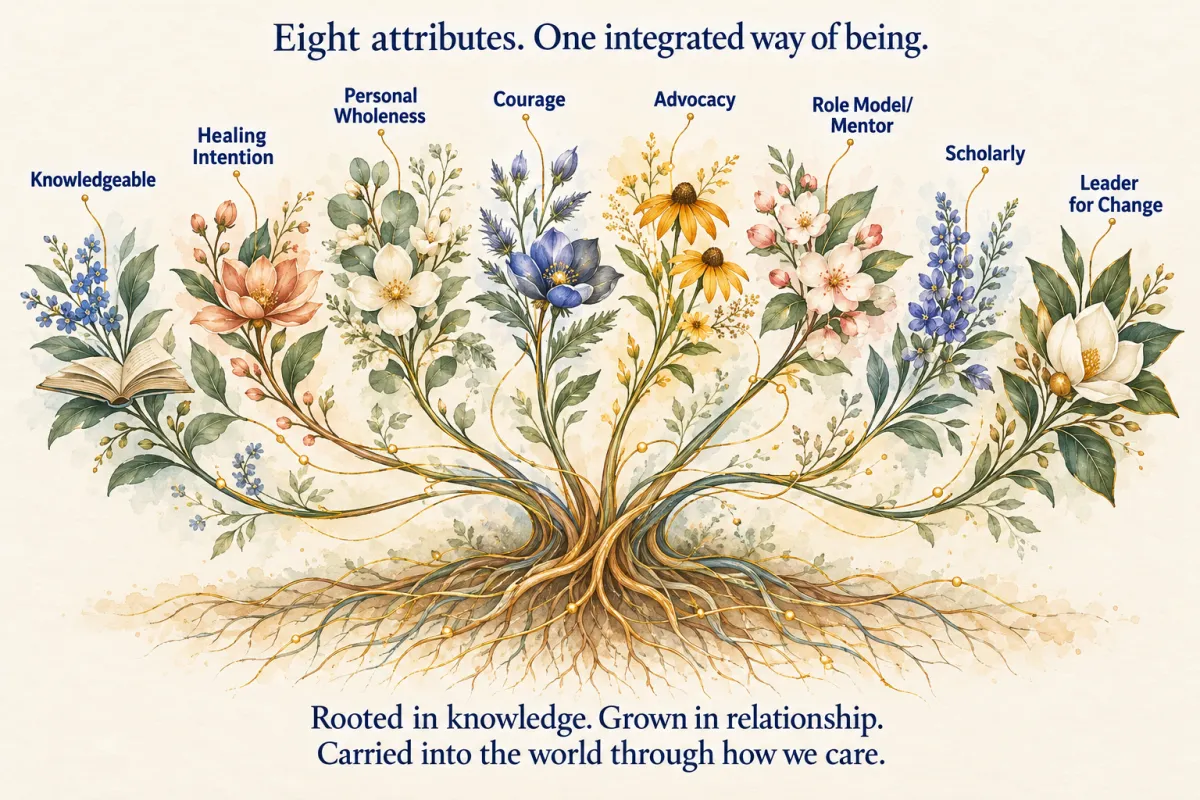
Eight attributes. Three levels. Learning that lives in your practice.
TIP 2.0 brings trauma science, developmental neuroscience, Caring Science, and relational practice together through eight attributes of a Trauma-Informed Professional.
Each attribute weaves together Science, Soul, and Skills: understanding the evidence, reflecting on your presence, and applying what you learn.
Level 1 - Foundations | Integration of Self
Explore Knowledgeable, Healing Intention, and Personal Wholeness as you deepen your understanding of trauma, your intentions in caring, and the grounding you bring to your work.
Level 2 - Empowerment | Integration of Voice and Influence
Develop Courage, Advocacy, and Role Model/Mentor as you strengthen your voice, navigate relationships, and support others in creating more humane care.
Level 3 - Transformation | Integration of Leadership and Change
Bring Scholarship and Leader for Change into focus as you connect evidence, systems thinking, and leadership—and draw all eight attributes together in your capstone.
Across these levels, three integration projects help you express what is changing in your understanding, relationships, practice, and leadership.
What is it like to participate in TIP?
You begin with your own experience: the encounters that stay with you, the questions you carry, and the changes you hope to make.
Learn at a pace that supports your life.
Explore the online modules independently, making space for reflection and application. Plan for approximately 2–4 hours a week, with about 48 hours of learning across the program. Core content guides your progress; optional readings and resources offer opportunities to go deeper.
Bring the learning into everyday moments.
A conversation with a family. A difficult interaction with a colleague. A decision about care. Reflective prompts and application activities help you examine these moments and practice responding with greater awareness and intention.
Connect through TIP Gatherings.
Live facilitated gatherings offer opportunities to build relationships, share reflections, explore real situations, and learn with and from other professionals. You are welcome wherever you are in your learning journey. Gatherings are optional enrichment and community-building opportunities. They are not required for certification and do not contribute to CE hours.
Make your learning visible.
Complete one integration project at each of the three levels, culminating in your capstone. You can choose a written, creative, practice-based, audio, video, or blended format that meaningfully expresses your growth.
To earn your TIP Certificate, complete all eight attribute modules, the required reflections, integration projects, and capstone.
You bring your questions. You practice in your own setting.
You grow in relationship.
Learn in Relationship. Integrate in Your Own Practice.

Guided Learning
Explore eight attributes through Science, Soul, and Skills, at a pace that supports meaningful learning.

Community & Enrichment
Connect, share reflections, and learn with others through optional live TIP Gatherings.

Practice Application
Bring learning into everyday practice through reflective activities and three integration projects.

Professional Certification
Earn your TIP Certificate by completing all eight modules, required activities, and integration projects, including your capstone.
Invest in how you care, practice, and lead.
Your tuition includes the full TIP 2.0 curriculum, reflective and application activities, three integration projects, and access to the TIP Forum and optional community gatherings. You also receive lifetime access to learning materials and future program updates.
Reflective Scholar Scholarship
Available now through December 31, 2026
Receive $500 off TIP 2.0 tuition using the coupon code for your preferred payment option.
No application. No explanation required.
Pay in Full — $1,000 USD with scholarship
Best Value
Standard tuition: $1,500 USD.
Use REFLECTFULL26 at checkout to receive $500 off.
Four-Month Payment Plan — $1,100 USD with scholarship
$275 per month for four months
Standard plan: $400 per month for four months ($1,600 total).
Use REFLECTPLAN26 at checkout to receive 31.25% off each installment - a $500 savings.
Need a Different Payment Arrangement?
If these options do not fit your circumstances, contact us to explore an extended payment arrangement.
Seeking Sponsorship?
Your employer or professional organization may be able to support your participation. Our sponsorship resource includes a program description, potential funding sources, and request templates to help you begin the conversation.
Frequently Asked Questions
Who is TIP 2.0 for?
TIP is designed for clinicians, educators, and leaders across healthcare, education, and human services who want to deepen their trauma-informed knowledge, relational practice, and capacity to influence change.
How does the program work?
You explore eight online attribute modules at your own pace, engaging with educational content, reflective prompts, and activities connected to your professional setting. The curriculum unfolds across three levels: Foundations, Empowerment, and Transformation.
Optional live TIP Gatherings offer additional opportunities for connection, reflection, and shared learning.
How much time should I plan for?
Plan for approximately 2–4 hours per week, adjusting your pace to support meaningful engagement. You can revisit material and spend more time applying what you learn. Optional enrichment resources allow you to explore topics more deeply.
What are the integration projects?
You complete one project at each of the three developmental levels. These invite you to bring the attributes together and explore what is changing in your awareness, relationships, practice, and leadership.
You may choose a written, creative, practice-based, audio, video, or blended format. Your final capstone integrates all eight attributes.
Do I need to attend live gatherings?
Live TIP Gatherings are optional enrichment and community-building opportunities. They do not contribute to CE hours and are not required for certification.
Gatherings are not recorded, helping preserve a space for candid reflection and dialogue.
What is required to earn my TIP Certificate?
Complete all eight attribute modules, the required reflective and application activities, and all three integration projects, which includes the Level 3 capstone.
Do I need to complete every reading and resource?
Each module identifies primary learning content and optional enrichment resources. Complete the required content and activities; use the additional readings and materials to follow your interests and deepen your understanding.

“I created TIP to help people carry trauma-informed care into their relationships, decisions, and leadership. My hope is that you leave with greater capacity to shape the conditions in which humane care can flourish.”
- Mary Coughlin, MS, NNP-NCC-E, Trauma-Informed Professional, Caritas Coach®
How you show up matters.
So do the conditions you create.
COMPANY
SUPPORT
LEGAL
© Copyright 2026. Caring Essentials. All Rights Reserved.