When Care Systems Begin to Mirror Coercion
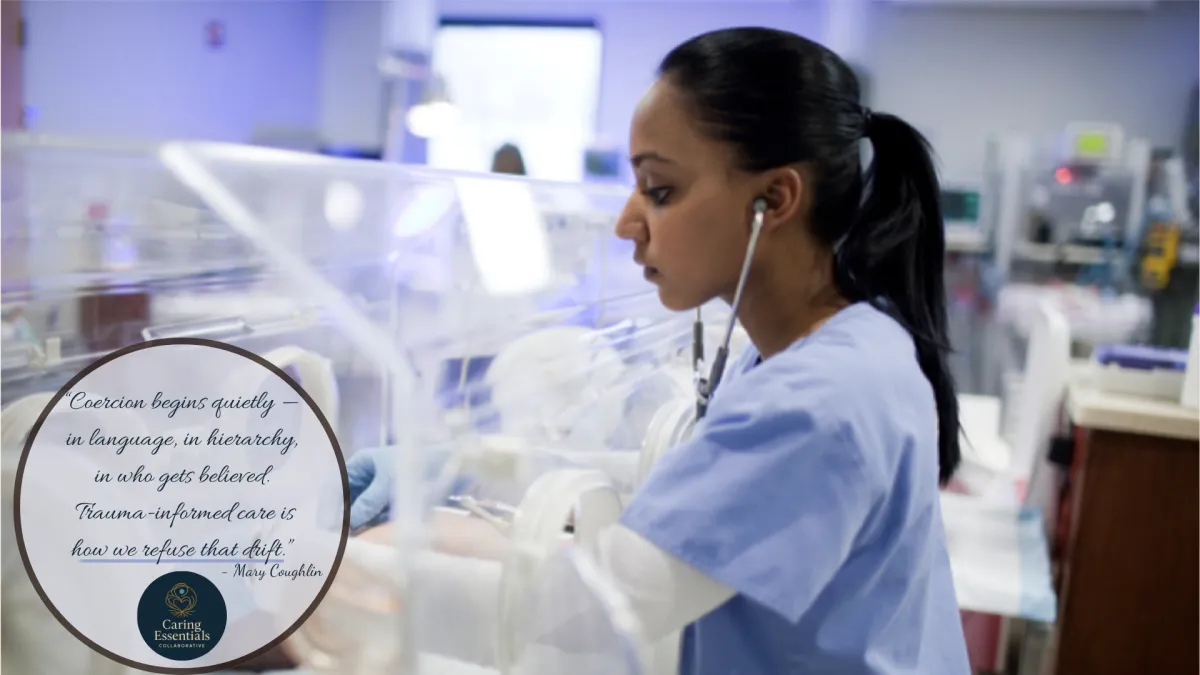
“When fear narrows a culture, care must widen it. If healthcare mirrors hierarchy under stress, it can also model dignity under pressure.” — Mary Coughlin
When Care Systems Begin to Mirror Coercion
Lifton’s Eight Criteria, Healthcare, and a World Under Stress
Lifton’s Eight Criteria, Healthcare, and a World Under Stress
There is a framework I keep returning to lately.
Psychiatrist Robert Jay Lifton described eight criteria of thought reform — patterns he observed in environments where psychological control gradually replaced relational freedom.
He wasn’t writing about healthcare. He wasn’t writing about today’s geopolitical climate. And yet — here we are.
Because when societies are under stress, systems tighten. Language narrows. Belonging becomes conditional. Dissent becomes dangerous.
And healthcare, as I’ve long believed, often mirrors the larger societal hierarchy in which it operates. This is not a claim of equivalence. It is an invitation to pattern recognition.
A World Under Pressure
Across the globe right now, we see:
Information ecosystems fracturing.
Leaders consolidating power under the banner of “security.”
Language simplifying complex realities into good versus evil.
Groups labeled as threats.
Loyalty tests increasing.
Dissent framed as betrayal.
Fear does this. When nervous systems are activated at scale, nuance feels unsafe. And in moments like this, Lifton’s framework becomes less historical artifact and more diagnostic lens.
The Eight Patterns — And Why They Matter
Lifton described environments characterized by:
Control of information.
Sacred, unquestionable doctrine.
Moral purity tests.
Simplified, emotionally loaded language.
Invalidation of lived experience.
Hierarchies of who is worthy to belong.
Read that list slowly.
None of these dynamics begin as overt tyranny. They begin as tightening; as certainty; as urgency; as “this is the only way.”
Healthcare Is Not Immune
Healthcare operates within the same stress currents as society.
When geopolitical instability rises, when funding tightens, when cultural polarization deepens, those pressures enter our hospitals, our NICUs, our leadership meetings.
And under strain, healthcare systems can drift toward:
Narrowed communication.
Increased hierarchy.
Zero-error moralization.
Labeling families as “difficult” or “non-compliant.”
Treating staff burnout as personal weakness.
Prioritizing institutional protection over relational repair.
We tell ourselves it’s about efficiency, or safety, or policy. And, sometimes it is, but sometimes it is fear, quietly reorganizing power.
The Subtle Drift
Thought reform is not a switch. It is a slope. It happens when:
“Evidence” becomes unquestionable dogma rather than evolving inquiry.
Reflection becomes confession without psychological safety.
Language becomes shorthand that erases complexity.
Personal experience is overridden by institutional doctrine.
Worthiness is unconsciously ranked.
In geopolitical spaces, this can look like nationalism framed as moral purity. In healthcare, it can look like perfectionism framed as professionalism.
Different arenas. Same nervous system.
Trauma at Scale
Trauma narrows perception. Under threat, humans move toward:
Certainty over curiosity.
Authority over dialogue.
Belonging through exclusion.
What we need to understand is that societies do this; institutions do this; and, healthcare teams do this.
It is not evidence of evil. It is evidence of dysregulation. But dysregulation at scale becomes policy and policy shapes human experience.
The Question We Must Ask
Not: “Is healthcare coercive?” But:
Where are we drifting toward control rather than connection?
Where is fear shaping language?
Where is dissent being quietly punished?
Where is belonging becoming conditional?
And perhaps most importantly: Are we defending institutional identity or protecting human dignity?
The Counterculture of Care
If Lifton’s criteria describe psychological capture, then trauma-informed leadership offers the antidote.
Open information flow.
Psychological safety.
Complex language.
Shared power.
Unconditional human worth.
Belonging that is not contingent on agreement.
Healthcare has the potential to model this for the world. Because at its best, care is the opposite of coercion. At its best, healthcare says:
You belong here.
Your experience matters.
We will not dispense with your existence.
A Mirror and an Invitation
We are living in a geopolitical moment where systems are tightening. That does not mean collapse is inevitable. But it does mean vigilance is necessary.
Healthcare can either absorb the fear of the culture — or model a different nervous system. The work of trauma-informed developmental care has always been about protecting the human in environments of stress. That mission now extends beyond the bedside. Because when care systems remain relational, transparent, and dignifying, they become quiet acts of resistance against coercive drift.
And in times like these, that matters. Deeply.
In defiance and love, Mary