When Democracy Falters, Collective Courage Matters Most
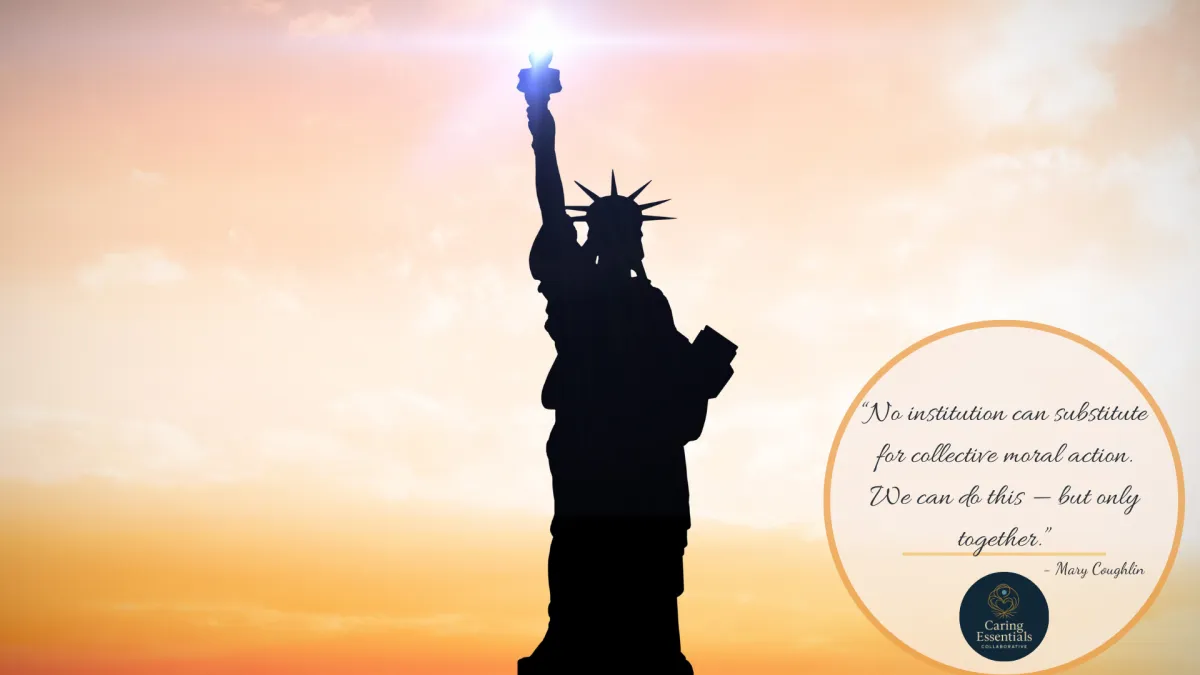
“No institution can substitute for collective moral action. We can do this — but only together.” - Mary Coughlin
When a System Becomes Septic
Diagnosis: This Is Systemic Illness, Not Political Disagreement
Source Control: Accountability Without Becoming the Infection
Treatment: The “Antibiotics” We Actually Need
Supportive Care: You Don’t Heal Sepsis by Ignoring the Organs in Shock
Monitoring: Health Is Maintained, Not Declared
The Hardest Truth and the Most Hopeful One
A Call to Action: What This Moment Actually Asks
What we are witnessing now is not new. It is newly visible.
The violence, coercion, extraction, and erosion of human dignity that shock us today have long existed beneath the surface of our national life—managed, narrated, normalized, and selectively obscured. What has changed is not the underlying pathology, but its presentation.
What once simmered quietly is now fulminant. What could be denied is now unmistakable.
This is what systemic illness looks like when it is allowed to progress unchecked.
In medicine, we have a name for this. Sepsis.
Sepsis is not a localized wound you can cover and hope will heal. It is what happens when infection overwhelms a body’s regulatory systems—when inflammation becomes dysregulated, organs begin to fail, and survival depends on timely, coordinated, ethical intervention.
A septic system does not recover through reassurance. It does not heal through denial. And it does not survive without source control, treatment, and sustained care.
Neither does a society.
Diagnosis: This Is Systemic Illness, Not Political Disagreement
Sepsis tells us something essential: the problem is not confined to one site. Likewise, what we are living through cannot be reduced to:
one leader,
one party,
one election,
or one ideology.
The illness is structural. It lives in:
unaccountable concentrations of power,
systems designed for extraction rather than care,
laws applied selectively rather than justly,
myths that protect identity instead of truth,
and a culture that treats harm as collateral rather than diagnostic.
The symptoms — polarization, fear, unrest, violence, despair — are not the disease. They are vital signs. And vital signs are meant to be read, not argued away. Naming this is not radical. It is responsible. In trauma-informed work, naming reality interrupts dissociation. In civic life, it interrupts normalization.
Source Control: Accountability Without Becoming the Infection
In medicine, treating sepsis requires source control—draining the abscess, removing necrotic tissue, stopping the ongoing insult. This is not vengeance. It is precision.
Civically, source control looks like:
constraining power that has become lawless,
ending impunity,
restoring ethical and legal limits,
and refusing to normalize violence simply because it wears authority.
This is where outrage can mislead us. Rage seeks annihilation. Care seeks preservation.
Excision without ethics leads to gangrene. Tolerance without intervention leads to death.
The discipline this moment requires is demanding and essential: be unwavering about accountability while remaining anchored in humanity.
That is not weakness. It is moral and civic skill.
Treatment: The “Antibiotics” We Actually Need
Antibiotics are rarely dramatic. They don’t make headlines. They work because they target mechanisms, not emotions. Our civic “antibiotics” are not slogans or saviors. They are sustained countermeasures:
rule of law applied consistently,
transparent governance with real consequences,
education that tells the full truth,
media literacy that resists manipulation,
economic systems that reduce desperation rather than exploit it,
structures that protect dignity, freedom, belonging, and accountability.
These measures do not feel revolutionary. They feel slow. They are how survival happens. And like antibiotics, they must be broad-spectrum — because the infection is.
Supportive Care: You Don’t Heal Sepsis by Ignoring the Organs in Shock
In sepsis, killing bacteria is not enough. You must support the organs under stress. In a society, that means protecting and resourcing:
educators who teach truth,
journalists who bear witness,
clinicians who name harm,
organizers who build alternatives,
communities already carrying the heaviest burden.
Burned-out people cannot sustain freedom. Exhausted systems cannot heal themselves. Care for the caregivers is not indulgence. It is survival strategy.
Monitoring: Health Is Maintained, Not Declared
Anyone who has treated sepsis knows relapse is real. There is no moment where we declare victory and move on. There is vigilance. Feedback. Adjustment. Shared responsibility.
The belief that democracy sustains itself without care is part of how we became ill. Health, personal or civic, is not a finish line. It is stewardship.
The Hardest Truth and the Most Hopeful One
Those of us who are outraged, committed to justice, and grounded in care are not outside the system.
We live inside it. We were shaped by it. Some of us were protected by it. Many were harmed by it. That means healing cannot come from simply expelling “bad actors” and declaring ourselves restored. We must change the conditions that allow harm to thrive.
This work is slower than revolution. Less gratifying than blame. More demanding than outrage. It is also how bodies and societies survive.
A Call to Action: What This Moment Actually Asks
Not panic. Not purity. Not performative outrage. It asks for disciplined courage. It asks us to say calmly, clearly, and together:
This is a breach of care.
This is not lawful.
This violates human dignity and freedom.
This is not what we consent to become.
Because trauma thrives in confusion. And authoritarianism thrives in silence.
Clarity is not cruelty. It is regulation.
A Map of Roles: We Are Not All Called to Do the Same Thing
No healthy system asks every cell to perform the same function. Here is how people can show up without burning out—or turning on one another:
Witnesses: Journalists, writers, artists, everyday truth-tellers → Name reality clearly. Refuse euphemism. Preserve memory.
Protectors: Lawyers, advocates, clinicians, ethicists → Intervene when harm occurs. Defend boundaries. Document breaches.
Educators: Teachers, parents, mentors → Teach truth. Build critical thinking. Interrupt inherited myths.
Builders: Organizers, policy thinkers, community leaders → Create alternatives. Strengthen local systems. Model accountability.
Sustainers: Caregivers, healers, neighbors → Tend relationships. Reduce isolation. Keep people regulated enough to stay engaged.
Stewards: Those with institutional power or access → Use it responsibly. Share it. Constrain it. Refuse to hide behind procedure.
No role is superior. All are necessary. A system heals when each part does its work and respects the work of others.
This Is the Moment We Choose One Another
Right now, the patient is critically ill. A democratic society cannot survive sustained lawlessness, state violence, abandonment of responsibility, and the normalization of cruelty no matter how familiar the symbols remain.
And here is the truth we must face without flinching: There is no one coming to save this for us.
No single leader. No institution. No process that can substitute for collective moral action.
That does not mean we are powerless. It means the responsibility is ours.
This is where the work turns inward, not into isolation, but into courage.
When systems are overwhelmed, the first task is regulation: ground, breathe, orient. And then act deliberately, together.
Recognizing our roles is not about adding burden. It is about relieving people of the lie that they must do everything alone.
You do not have to fix democracy by yourself. You do not have to agree on everything. You do not have to be fearless. You have to be willing.
Willing to show up where you are. Willing to speak the truth you can speak. Willing to hold your part of the line. Willing to stay connected across difference.
This is how humans have survived every real crisis, not through sameness, but through coordination. Not through purity, but through solidarity. Not through waiting, but through shared resolve.
Democracy has always been fragile. It survives only when people choose dignity, freedom, and care, again, and again, and again.
This is one of those moments. And we can do this — but only together.
We choose care. We choose courage. We choose one another.
Mary