The Constitution Cannot Save Us From Ourselves
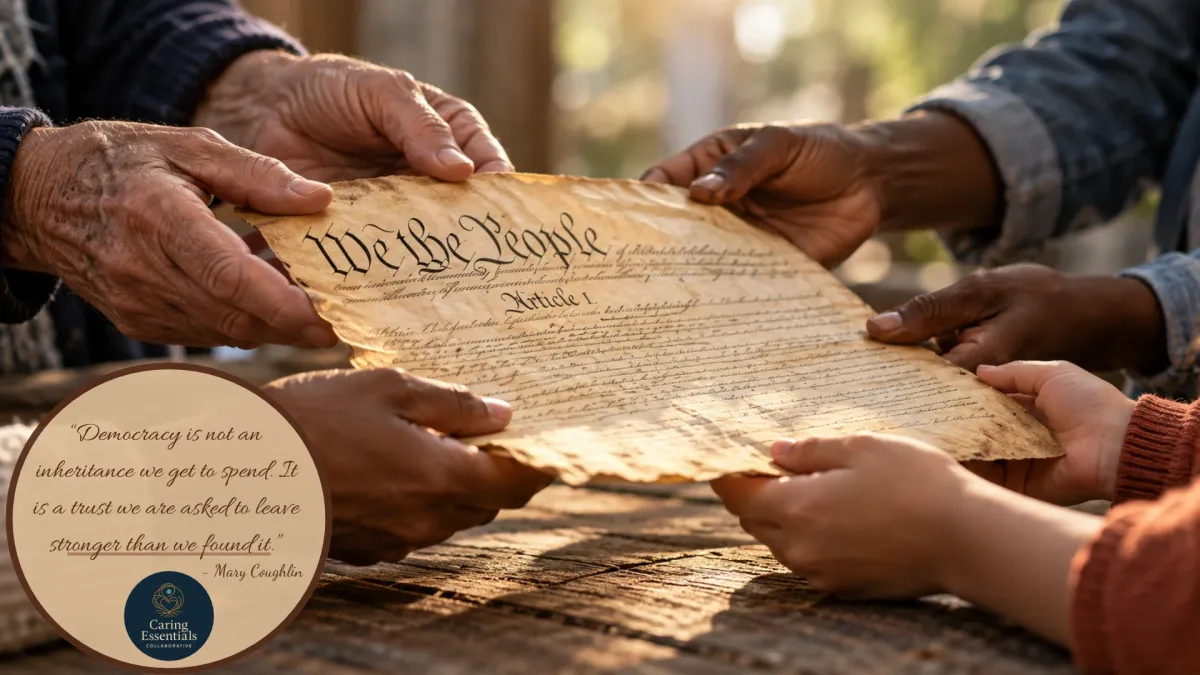
“Democracy is not an inheritance we get to spend. It is a trust we are asked to leave stronger than we found it.” — Mary Coughlin
The Constitution Cannot Save Us From Ourselves
Stewardship and the unfinished United States experiment in constitutional democracy
The promise and peril of spaciousness
Power requires something more than permission
Stewardship and the unfinished United States experiment in constitutional democracy
The United States experiment in constitutional democracy was never designed to run on autopilot.
We have a tendency to speak about the Constitution as though it were a protective force unto itself; as though somewhere beneath the noise of politics sits a nearly 240-year-old document quietly keeping democracy safe.
It cannot.
The Constitution is paper. Extraordinary paper, certainly. Visionary in many respects and deeply compromised in others. It was written by imperfect human beings attempting something audacious: to create a government powerful enough to govern and constrained enough not to become tyranny.
They did not finish the work. They couldn't. They left it to us.
The promise and peril of spaciousness
The Constitution does not provide instructions for every circumstance the people of the United States will encounter. It creates a structure: legislative power, executive power, judicial power; authority divided so that power is not simply concentrated in one place.
And then it gives us extraordinary words and ideas: justice, liberty, equal protection, due process, freedom.
Words spacious enough to survive centuries.
That spaciousness may be one of the Constitution's greatest strengths. It allows principles written in another age to meet circumstances their authors could never have imagined. But it is also one of the document's vulnerabilities, because eventually human beings must decide what those words mean.
Judges interpret them. Presidents test the boundaries of their authority. Legislators decide what government should and should not do. Lawyers construct arguments around them. Citizens decide what they will tolerate.
And human beings are extraordinarily talented at finding interpretations of principle that accommodate what they already want.
Sometimes that is simply the work of democracy. People disagree about the meaning of liberty, the boundaries of governmental authority, or how competing rights should be reconciled.
But there is another possibility we should be willing to name: spaciousness can be exploited.
An ambiguity can become a loophole. An exception can become a precedent. A power exercised once under extraordinary circumstances can become normalized. A constitutional restraint can slowly be interpreted into irrelevance.
The people who demanded a Bill of Rights understood something about this danger from the beginning. The preamble accompanying the proposed amendments described their purpose, in part, as preventing the “misconstruction or abuse” of governmental power. National Archives
The architecture mattered. But so did the people entrusted with it. And that is why democracy requires something no constitution can manufacture for us: character.
Power requires something more than permission
There is an enormous difference between exercising power and stewarding it.
The person interested primarily in exercising power asks, Can I do this?
The steward asks something more difficult: Should I? What precedent will I establish? What restraint am I weakening? Whose liberty becomes more vulnerable because of this decision? And would I still believe this power was legitimate if it belonged to someone I feared?
That last question matters.
Because constitutional democracy cannot depend upon which political faction happens to hold power. If an authority seems perfectly reasonable when someone we support possesses it but terrifying when someone we oppose does, perhaps we need to examine the standard we are using.
Integrity asks something difficult of us: respect the restraint even when violating it would advance something we desperately want.
That is a much harder form of leadership.
An unfinished promise
None of this requires romanticizing the founding of the United States.
The original constitutional order accommodated slavery. Women did not possess equal political power. Indigenous peoples were excluded and dispossessed. The promise contained within We the People was vastly larger than the population actually permitted to participate in defining the we.
And yet the story did not end in 1787.
The Constitution was amended. Slavery was abolished. Birthright citizenship and equal protection became constitutional commitments. Voting rights expanded. Women gained constitutional protection for the right to vote. The voting age eventually became 18.
That history matters because it reminds us that this constitutional experiment has never been preservation in amber. It has been an unfinished argument about what freedom, equality, citizenship and self-government should mean and about who is actually included when we say We the People.
That argument continues.
We continue to debate the reach of presidential authority, the independence of governmental institutions, religious liberty and civil rights, gun rights, citizenship, voting rights, congressional authority, states' rights, equal protection, and the power of courts to determine what words written generations ago require of us today.
People of good faith will sometimes reach profoundly different conclusions about those questions.
That is not the danger.
The danger begins when the rules themselves matter only when they constrain the other side.
It begins when loyalty becomes more important than truth; when winning becomes more important than legitimacy; when constitutional restraints become obstacles to be maneuvered around rather than protections worth preserving.
It happens when political opponents become enemies rather than fellow citizens. When human beings become categories. When cruelty becomes confused with strength. When expertise becomes suspicious simply because it complicates what we want to believe.
And perhaps most dangerously, it happens when ordinary people become so exhausted by all of it that we stop paying attention.
Democracy needs witnesses
We often reduce citizenship to voting.
Voting matters enormously.
But democracy asks considerably more of us than appearing at a polling place every few years.
Citizenship means paying attention to what people entrusted with power actually do. Reading beyond the headline. Understanding what a court decided rather than simply accepting someone else's description of it. Calling a legislator. Attending a local meeting. Supporting independent journalism. Organizing. Writing. Peacefully protesting. Listening to people whose experiences are different from our own.
It also means refusing to outsource our conscience to a political party.
We should expect integrity from the people we elect, regardless of the letter beside their name. We should expect judges to exercise enormous authority with humility. We should expect presidents to recognize that constitutional limits remain limits even when those limits frustrate their ambitions.
And we should be willing to hold our own side accountable when it fails those tests.
Perhaps that is one of the most meaningful acts of democratic citizenship available to us: refusing to surrender our moral judgment to the comfort of belonging.
We the People was never a spectator role
Those first three words are easy to overlook.
We the People.
But it is worth remembering what the document actually says: We the People of the United States.
Not they, the government. Not they, the judges. Not they, the politicians.
We.
If governmental authority ultimately comes from the people, then responsibility for constitutional democracy cannot be outsourced entirely to presidents, courts or Congress.
We inherit this experiment. We examine it honestly. We acknowledge where it has failed. We protect what is precious within it. We push it toward promises it has not yet fulfilled.
And eventually, we hand it forward.
That is stewardship.
There is something extraordinary in discovering that this idea was present at the very beginning of the constitutional government itself.
In his first inaugural address in 1789, George Washington spoke about virtue, duty, public morality and the responsibilities carried by those entrusted with government. Near the conclusion, he described the still-fragile republican system as an “experiment entrusted to the hands of the American people.”National Archives
The historical language is his, and I preserve it here as such.
But the idea transcends the terminology: An experiment entrusted to the people.
Perhaps that is the part we have forgotten.
This constitutional democracy was never entrusted only to presidents, legislators or judges.
It was entrusted to us.
This is our watch
I do not believe protecting democracy requires pretending the United States has always lived up to its ideals.
In fact, I believe the opposite. Loving an experiment enough to preserve it requires being willing to see clearly where it has fallen short.
The Constitution itself begins not by declaring a perfect union, but by aspiring to form “a more perfect Union.” It names justice, general welfare and liberty among the purposes of the government being created. National Archives
More perfect.
There is humility in those words, but there is also an assignment.
Every generation inherits some distance between the promises of the United States and its practices. Ours is no exception. The question is what we do with that distance.
We can become cynical. We can retreat into our tribes. We can surrender our attention. We can decide politics is ugly and therefore somebody else can worry about it.
Or we can recognize what has always been true: Democracy is not an inheritance we get to spend. It is a trust we are asked to leave stronger than we found it.
So yes, vote. But don't stop there.
Learn what is happening. Ask questions. Read deeply. Speak when something is wrong. Organize. Listen. Show up. Protect another person's dignity even when doing so earns you nothing. Pay attention to who is accumulating power and who is losing the ability to challenge it.
And when someone asks to exercise more power, ask one deceptively simple question:
Would I still believe this power was legitimate if it belonged to someone I feared?
The Constitution cannot answer that question for us.
It cannot make our leaders virtuous. It cannot make judges humble. It cannot make citizens pay attention. And it cannot guarantee that those entrusted with power will exercise restraint.
That part of the experiment was entrusted to us.
We are not merely its beneficiaries.
We are its stewards.
And this is our watch.
In stewardship,
Mary
A note on language
Throughout this reflection, I have intentionally used United States rather than America when referring specifically to this country. The United States is one nation within the Americas, home to many nations, peoples, cultures and histories. Historical quotations retain the language of their authors. Language shapes what and whom we learn to see.
Sources & Further Reading
National Archives and Records Administration.The Constitution of the United States. Includes the original text, transcript, amendments and historical context. National Archives
National Archives and Records Administration.The Bill of Rights. The preamble to the proposed amendments explicitly refers to preventing the “misconstruction or abuse” of governmental powers. National Archives
National Archives and Records Administration.A More Perfect Union: The Creation of the U.S. Constitution. Historical background on the Constitutional Convention, drafting and ratification of the Constitution. National Archives
Washington, George. (1789, April 30). First Inaugural Address. National Archives and Records Administration. Washington discusses rectitude, patriotism, morality, liberty and the republican “experiment entrusted to the hands of the American people.”