Belonging, Understanding, and the Courage to See Clearly
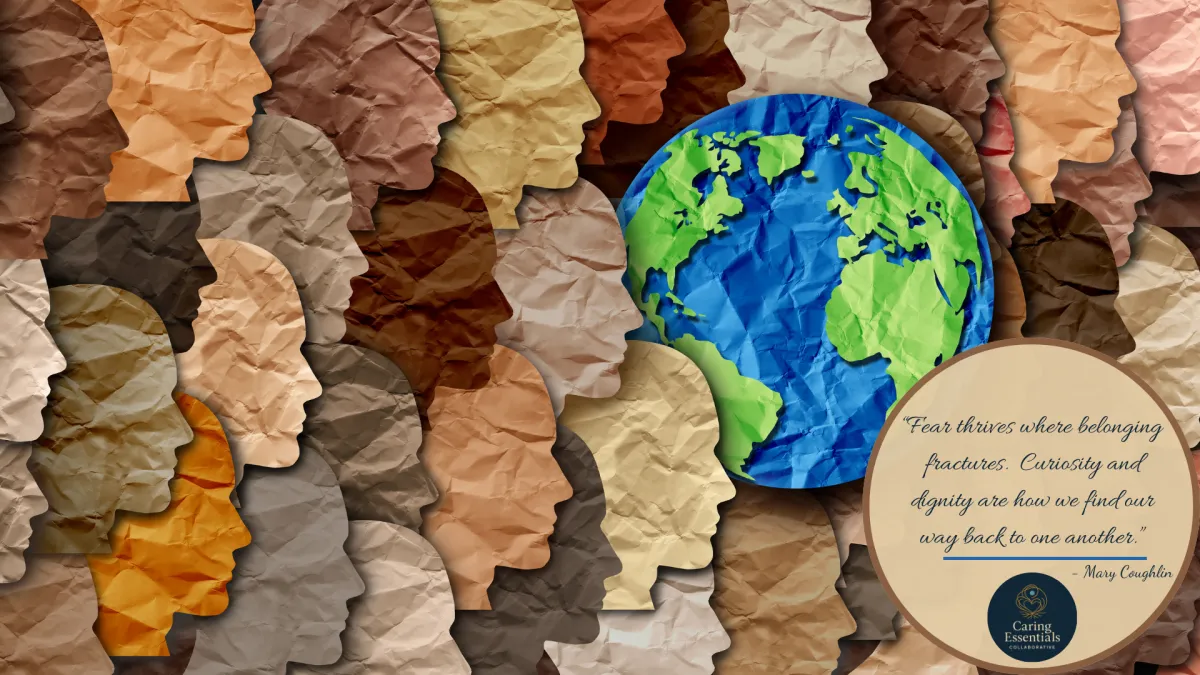
“Fear thrives where belonging fractures.Curiosity and dignity are how we find our way back to one another.” - Mary Coughin
Belonging, Understanding, and the Courage to See Clearly
The Shaping of Knowledge and the Shaping of Us
When Separateness Replaces Belonging
We are living in a time of profound division but what I notice most is not disagreement. It is disconnection. So many people are moving through the world with a quiet sense of loneliness, unease, and threat that often shows up as anger, rigidity, or intolerance. Fear feels closer to the surface. Curiosity feels harder to access. And dignity, both our own and one another’s, too easily slips out of reach.
From a trauma-informed lens, this makes sense.
When people are disconnected from belonging, when shared meaning fractures, nervous systems move into protection. The world narrows. “Us versus them” begins to feel safer than uncertainty. And complexity (historical, relational, human) starts to feel threatening rather than grounding.
What we are experiencing is not simply a social phenomenon. It is a relational one. And it has roots.
The Shaping of Knowledge and the Shaping of Us
The fragmentation we see today did not emerge overnight. It was shaped over generations through histories that were intentionally edited, through institutions that centralized certain voices while excluding others, and through systems that rewarded compliance over curiosity.
The intentional shaping of knowledge did not stop in childhood classrooms. It continued quietly and persistently through adult professional formation. In medicine. In nursing. In education. In law. In policy.
These professions did not exist outside history; they were built within it. Decisions about whose knowledge was credible, whose experiences were “objective,” whose pain was believed, and whose voices were dismissed were shaped by power. Certain narratives were elevated. Others were erased.
In healthcare, the consequences have been devastating and enduring: Black pain minimized, racialized harm rendered invisible, white norms presented as universal standards of care. In nursing and medicine, many of us were socialized into hierarchy and silence. taught to stay in our lane, to follow protocol without question, to value efficiency over inquiry, and to absorb “truth” without examining who defined it or who was excluded in the process.
This is not about individual blame. It is about professional formation.
And it matters deeply, because trauma-informed care asks us to meet people where they are. But, that is impossible if we refuse to understand how folks got there they are, historically, socially, and structurally.
When Separateness Replaces Belonging
One of the most effective ways harm sustains itself is through separateness.
When history is fragmented. When professions operate in silos. When curiosity is discouraged. When questioning is framed as disruption rather than responsibility.
Trauma-informed science teaches us that isolation increases vulnerability. The same is true for individuals, professions, and societies. When we are separated from shared truth and shared humanity, fear fills the gap. And fear, when left unnamed or unsupported, often emerges as anger, intolerance, rigidity, or blame. This is not a moral failure. It is a human one.
Loneliness sits beneath much of what we are witnessing right now. Loneliness born of lost belonging. Loneliness born of systems that taught us to compete rather than relate, to defend rather than understand, to protect certainty instead of dignity. When belonging fractures, fear takes over. When understanding is absent, judgment rushes in.
Trauma-Informed Care Is Justice Work
This is why trauma-informed care cannot be reduced to kindness, tone, or interpersonal technique. At its core, trauma-informed work is truth-telling work. It is belonging work. It is understanding work.
Belonging asks: Who has been excluded, erased, or rendered invisible—and how does that live on in bodies and systems today? Understanding asks: What history, power, and context shaped this moment, this response, this person? Curiosity changes the game here.
Not curiosity as debate or voyeurism, but curiosity rooted in dignity, the kind that says, I don’t know everything, and I am willing to learn. The kind that resists simple stories and instead leans toward relationship. Dignity changes the game too. Dignity reminds us that no one is reducible to a single behavior, belief, or moment. That harm must be named clearly and humanity must not be erased in the process.
This is the heart of Trauma-Informed Developmental Care. This is the spirit of the B.U.F.F.E.R. framework. And this is why justice is not an “add-on” to trauma-informed work, it is the ground it stands on.
Reclaiming What Connects Us
The work before us is not about guilt. It is about responsibility. Responsibility to unlearn what we were taught to ignore. Responsibility to question whose voices shaped our professions. Responsibility to step out of silos and into relationship. Responsibility to choose curiosity over certainty, and dignity over domination.
When we reconnect to fuller histories, to one another, to our shared humanity we restore discernment. When we approach difference with understanding rather than fear, we reduce the conditions that allow anger and intolerance to take root. This is not about agreement. It is about presence. It is about belonging. It is about understanding.
Healing—personal, professional, and societal—has always depended on relationship.
And that is the work I am committed to.
Take care and care well, Mary