A Prescription for Peace: A Trauma-Informed Framework for Ending Global Conflict
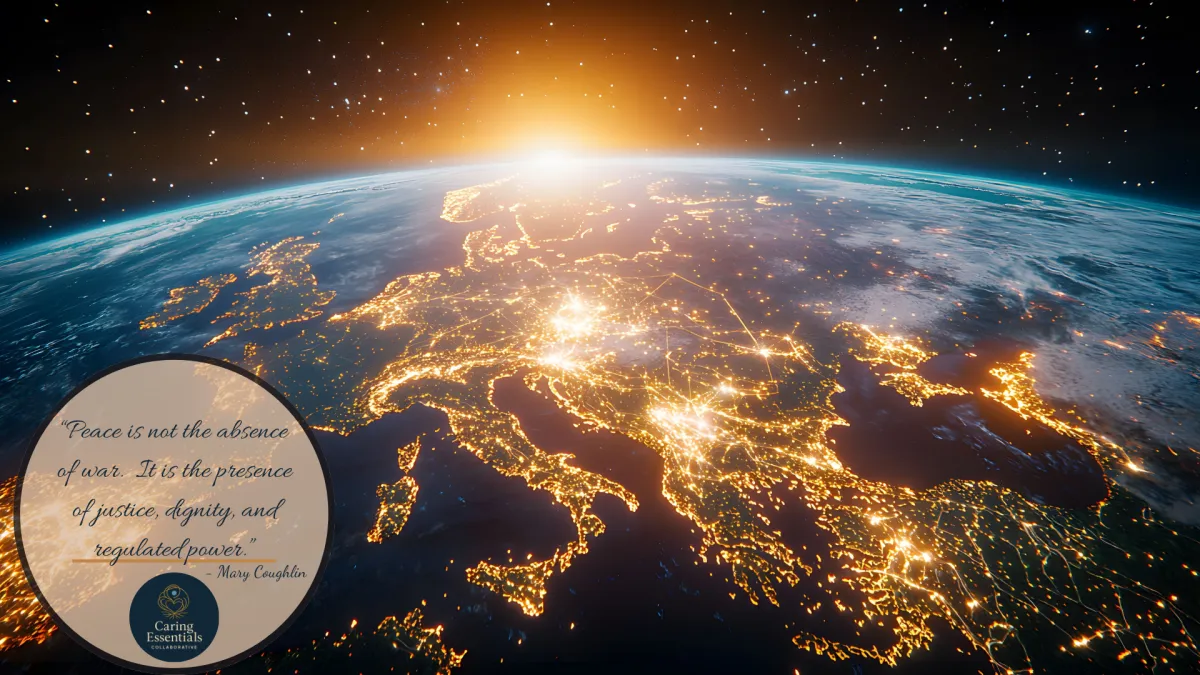
“Peace is not the absence of war. It is the presence of justice, dignity, and regulated power.” — Mary Coughlin
A Prescription for Peace
What if the world is not evil, but dysregulated? I know this sounds simple. But I keep coming back to it: Why can’t we just respect each other and live in peace?
Not as a bumper sticker. Not as spiritual bypassing. But as a real, aching question.
When I look at the wars unfolding, the regime rhetoric, the escalation, the posturing, the fear I don’t see only strategy. I see dysregulation.
If the world were my patient, I would not begin with blame. I would begin with assessment. And what I see beneath so much global distress is this: A nervous system operating in survival mode.
The Unnamed Driver
Fear of annihilation. Fear of humiliation. Fear of losing power. Fear of losing identity. Fear of becoming irrelevant.
When individuals are afraid, they fight, flee, freeze, or control. When nations are afraid, they arm, dominate, sanction, bomb, and posture. Fear rarely introduces itself honestly.It disguises itself as righteousness.
“We had no choice.”
“This is self-defense.”
“This is existential.”
Underneath, there is often fear. And fear, when unregulated, escalates.
If the World Were My Patient
The first intervention would not be ideology. It would be stabilization. You cannot heal a body that is still hemorrhaging.
First: stop the bleeding.
Ceasefires.
Humanitarian corridors.
Protection of civilians.
An end to language that dehumanizes entire populations.
Dehumanization is collective nervous system collapse.
Second: restore safety.
Not dominance disguised as security.
Not control framed as protection.
True safety means predictability. Dignity. Access to food, water, medicine, education. The ability to sleep without sirens.
Safety must belong to everyone or it becomes domination.
The Harder Work
After stabilization comes the deeper treatment. Truth-telling without humiliation. Accountability without annihilation. Shared grief rather than weaponized grief.
Peace is not the absence of war. It is the presence of justice. And justice is not vengeance. It is repair.
Repair requires courage from the powerful.
It requires sharing resources. Sharing land. Sharing narrative. Sharing power.
That is where peace often stalls. Because trauma simplifies. Trauma says: Eliminate the threat.
Healing says: Understand the system.
Why Peace Feels So Fragile
When collective trauma shapes policy, compromise feels like erasure. When identity feels threatened, power tightens. When humiliation is unresolved, retaliation feels righteous.
Every side believes it is defending itself. And the spiral continues. No actor in this story has clean hands. Some hold more power. Some suffer more visibly. All are embedded in history.
Understanding that does not excuse harm. But it does explain rigidity.
A Real Prescription
If I were writing a treatment plan for the world, it would include:
Radical Belonging over exclusion
Understanding over projection
Forgiveness that does not erase accountability
Frameworks that reward cooperation over dominance
Equanimity over urgency-driven escalation
Respect, especially when it feels hardest
Peace is not passive. It is disciplined. It requires leaders who can tolerate vulnerability. It requires institutions that reduce humiliation instead of amplify it. It requires media that does not profit from outrage. And it requires ordinary people, you and me, to resist the urge to dehumanize, even when we are furious.
The Truth That Grounds Me
Humans are capable of war. But we are also capable of repair.
Former enemies have reconciled before. Nations have rebuilt trust before. Cycles have been interrupted before. Not because fear disappeared. But because enough people refused to let fear write the future.
Peace is not naïve. It is regulated power. It is shared dignity. It is restraint. And maybe the most radical starting point is this:
Name the fear.
Regulate the nervous system.
And remember: no flag cancels our shared humanity — every person, regardless of allegiance, carries a nervous system, a story, and an inherent right to dignity.
Reflection Invitation
If you sit quietly with the questions: Where does fear live in this conflict? and What would safety look like for all sides? Notice what arises.
Peace does not begin in treaties. It begins in how we see each other.
Take care and care well, Mary