When the Economy Grows but People Struggle: A Trauma-Informed View
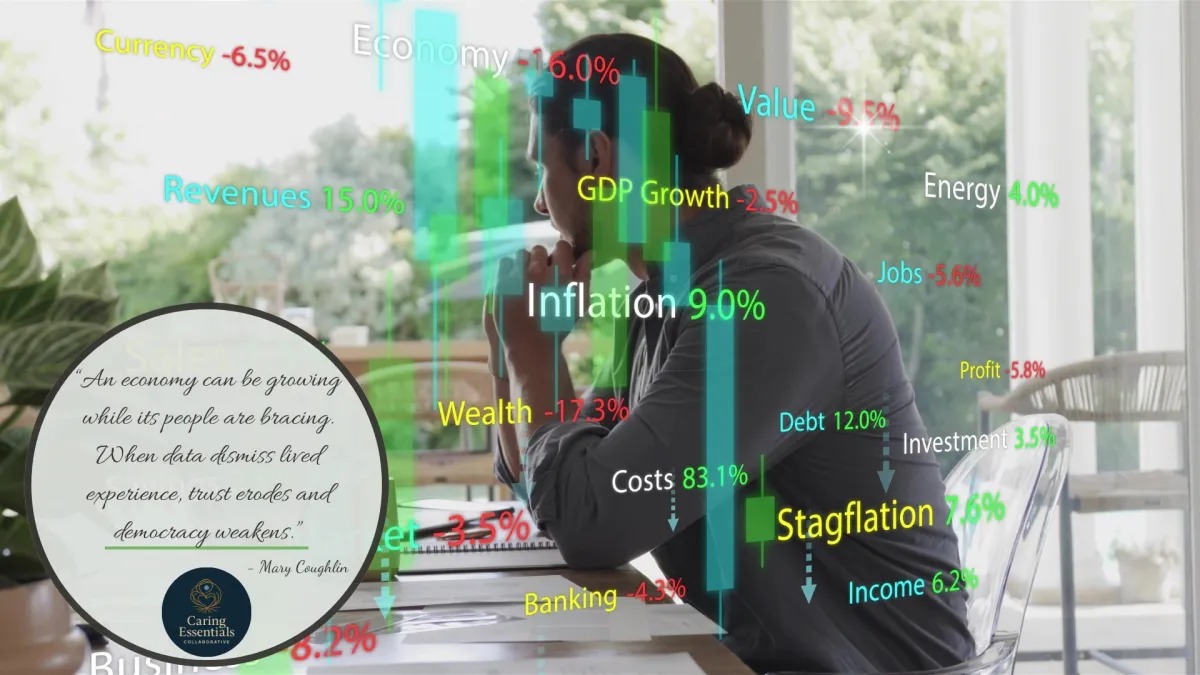
“An economy can be growing while its people are bracing.When data dismiss lived experience, trust erodes and democracy weakens.” - Mary Coughlin
When “Growth” Doesn’t Feel Like Growth
A Trauma-Informed Look at the Economy—and Why It Matters for Democracy
GDP Grows. People Struggle. Both Can Be True.
Who Is Actually Driving This “Growth”?
Why This Matters Through a Trauma-Informed Lens
Early Spending Isn’t Confidence—It’s Coping
A Trauma-Informed Look at the Economy—and Why It Matters for Democracy
We’re being told the economy is growing.
Headlines report strong GDP numbers. Politicians point to quarterly gains. Markets respond favorably. And yet—many people are cutting back, dipping into savings, carrying more debt, and feeling increasingly anxious about what lies ahead.
This disconnect isn’t imagined. And it isn’t irrational.
It’s the predictable outcome of how we measure “success,” who benefits from it, and whose experience is left out of the story.
Let’s slow this down—together.
GDP Grows. People Struggle. Both Can Be True.
Gross Domestic Product (GDP) measures economic activity, not economic wellbeing. It counts dollars, not dignity. Output, not security. Spending, not stability.
When GDP rises, it can mean:
Higher consumer spending
Increased government outlays
Strong asset markets
Short-term surges in activity
What it does not tell us is:
Whether wages kept up with costs
Whether families feel safe or solvent
Whether people can absorb another shock
Whether growth is broadly shared or narrowly concentrated
GDP is an average. And averages hide fractures.
Who Is Actually Driving This “Growth”?
When economists disaggregate the data—looking at spending and contribution by income level—a clear pattern emerges:
Higher-income households are driving most of the recent economic growth.
The top income groups account for a disproportionately large share of consumer spending
Asset holders benefit from rising markets and interest income
Higher-income households are more able to front-load purchases (including early holiday shopping to get ahead of expected price increases or tariffs)
Meanwhile:
Middle-income households are tightening budgets and leaning more heavily on credit
Lower-income households are pulling back altogether—often out of necessity, not choice
Savings buffers are thinner
Stress is higher
Resilience is lower
This means the economy can “grow” on paper while a majority of people feel increasingly precarious.
That’s not a failure of perception.
That’s a failure of alignment.
Why This Matters Through a Trauma-Informed Lens
Trauma-informed care asks us to notice mismatches between narrative and lived experience.
When people are told:
“The economy is strong”
…while their own experience says:
“I’m not okay”
…it creates a rupture in trust.
This is not just economic.
It’s relational.
And it’s civic.
Persistent invalidation—being told things are fine when they don’t feel fine—mirrors dynamics we recognize in trauma: loss of voice, erosion of agency, and pressure to override one’s own knowing.
Over time, that undermines engagement. People withdraw. Or disengage. Or become susceptible to simplified explanations and false promises.
Enter the B.U.F.F.E.R.™ Lens
This is where the B.U.F.F.E.R. framework offers both clarity and a way forward.
Belonging
Who does our economic narrative include—and who is invisible within it?
Understanding
Are we explaining growth honestly, including its uneven distribution and fragility?
Forgiveness
Can we make room for people who feel disillusioned or angry—not as failures, but as humans responding to real stress?
Frameworks
GDP alone is not enough. We need measures that reflect resilience, equity, and lived wellbeing.
Equanimity
Can we stay grounded and curious rather than reactive or dismissive—especially when the data are complex?
Respect
Do our policies and messaging honor people’s real experiences, or ask them to tolerate cognitive dissonance?
Early Spending Isn’t Confidence—It’s Coping
You may have heard that some people increased early holiday shopping to get ahead of potential price increases or tariff impacts.
That’s not optimism.
That’s anticipatory stress behavior—a rational response to uncertainty, most accessible to those with financial flexibility. It can temporarily boost GDP while masking deeper fragility underneath.
Coping strategies should not be mistaken for confidence.
Why This Is a Call to Civic Care
This isn’t about declaring a recession or dismissing data.
It’s about telling the whole truth—and refusing to confuse activity with health.
A trauma-informed society:
Disaggregates data
Names inequity honestly
Listens to lived experience
Designs policy with buffers, not just benchmarks
Democracy depends on trust.
Trust depends on truth.
Truth depends on whether people feel seen.
An Invitation
What would change if we asked not only:
“Is the economy growing?”
…but also:
“Who is carrying the cost?”
“Who is buffered—and who is exposed?”
“What would economic success look like if safety, dignity, and belonging were the goal?”
These are not partisan questions.
They are human ones.
And they are an invitation—to pay attention, to speak honestly, and to advocate for systems that care for the whole.
Because growth that leaves people behind isn’t progress.
And caring—truly caring—is essential.
#CaringIsEssential
In care and courage,
Mary