The Stewardship Revolution: Reimagining Humanity Beyond Survival
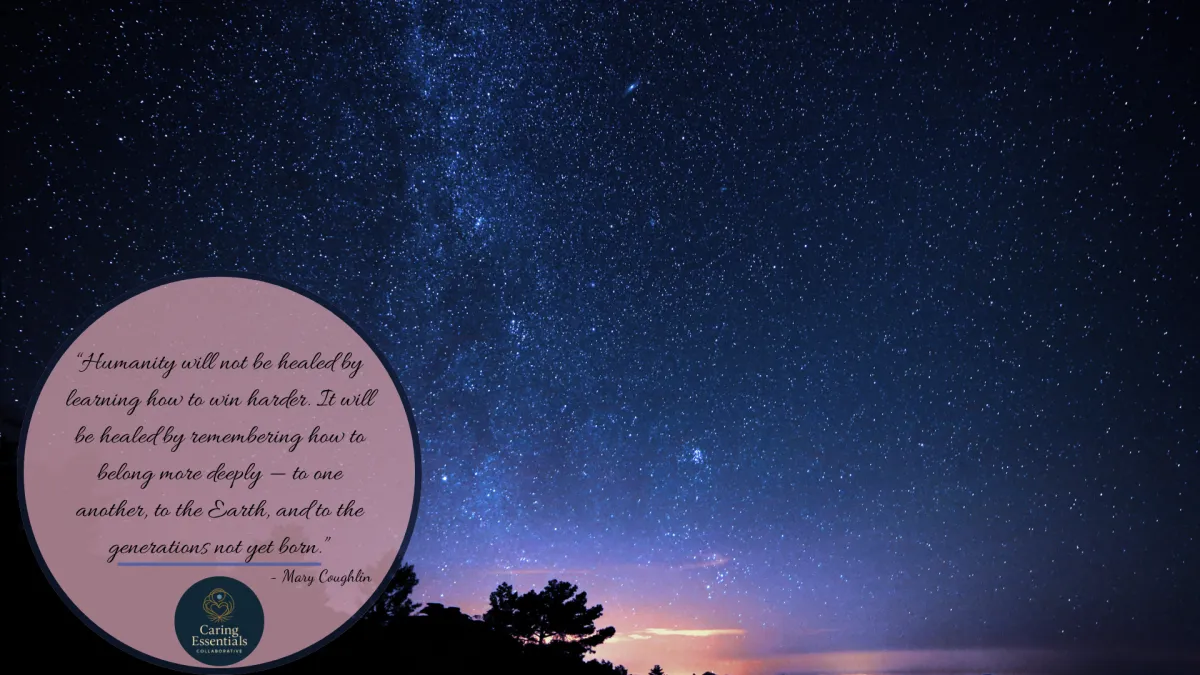
“Humanity will not be healed by learning how to win harder. It will be healed by remembering how to belong more deeply — to one another, to the Earth, and to the generations not yet born.” — Mary Coughlin
Reimagining Humanity Beyond Survival
There comes a moment in the life of a people when the old story stops making sense.
Not because it collapses all at once. Not because everyone suddenly agrees. But because something deep in the human spirit begins to whisper: This cannot be the fullest expression of who we are.
We are living inside such a moment now.
Across the world, people are exhausted. Not simply tired — existentially weary.
We are anxious in systems that demand endless productivity. Lonely in cultures obsessed with performance. Disconnected in a world more technologically linked than ever before.
Surrounded by abundance and yet conditioned to believe there is never enough.
Enough time.
Enough money.
Enough safety.
Enough worth.
Enough belonging.
Enough future.
And so we live braced. Braced against one another. Braced against uncertainty. Braced against the possibility of falling behind, being cast out, becoming irrelevant, disposable, unseen.
We have normalized survival as a way of life.
And perhaps most dangerously, we have mistaken survival for humanity itself.
But what if the crises unfolding around us — political polarization, ecological collapse, democratic erosion, loneliness, violence, burnout, authoritarianism, and despair — are not separate crises at all?
What if they are symptoms of the same wound?
A civilization organized around chronic disconnection.
Disconnection from one another.
Disconnection from the Earth.
Disconnection from our bodies.
Disconnection from grief.
Disconnection from meaning.
Disconnection from the sacred responsibility of being human.
For centuries, many of our dominant systems have been shaped by extraction: extracting labor, attention, resources, land, energy, identity, even worth.
We were taught that more is always better. That competition is inevitable. That vulnerability is weakness. That domination equals strength. That success belongs to those who accumulate the most. And yet here we stand: wealthier than any civilization in history and profoundly unwell.
The problem is not simply political or economic or even technological. It is developmental, relational, ecological, and spiritual.
Human beings are not machines. We are relational organisms. We come into the world dependent upon attunement. Our nervous systems develop through connection. Our brains are shaped by safety, belonging, touch, voice, responsiveness, and care.
This is not sentimentalism. It is biology.
And when human beings are chronically deprived of safety, dignity, regulation, and belonging, survival begins to organize behavior. Fear replaces trust. Scarcity replaces generosity. Control replaces relationship. Outrage replaces reflection. Domination replaces stewardship.
At scale, entire societies can become dysregulated. We are witnessing this now.
But another possibility is emerging too. Quietly. Persistently. Across disciplines, communities, generations, and cultures, people are beginning to remember something ancient: We belong to one another.
Not in a simplistic or utopian sense. Not without conflict, difference, accountability, or pain. But in the deepest biological and ecological sense.
The air we breathe is shared.
The climate is shared.
The nervous system of a child is shaped by the nervous systems around them.
The suffering of one community eventually reverberates outward.
The healing of one community does too.
This realization changes everything. Because once we understand interdependence, stewardship becomes unavoidable. The question is no longer: “How much can we take?” But: “What are we responsible for protecting, nurturing, and passing forward?”
This is the Stewardship Revolution.
A movement away from domination and toward relationship.
A reimagining of success not as endless accumulation, but as collective flourishing.
A commitment to building systems rooted in:
dignity
belonging
reciprocity
accountability
ecological wisdom
relational health
future generations
It asks us to grow beyond survival consciousness. Beyond the idea that safety can be achieved through hoarding, exclusion, and control. It asks us to become mature enough to hold both individuality and interdependence. Both freedom and responsibility. Both innovation and restraint. Both truth and compassion.
This is not a call to abandon ambition, science, technology, or progress. It is a call to reorient them toward life. Toward conditions that allow human beings — and the Earth itself — to flourish.
What would it mean to organize societies around developmental health rather than market anxiety?
What would it mean to treat caregiving as essential infrastructure?
What would it mean for education to cultivate wisdom instead of compliance?
What would it mean for leadership to be measured not by dominance, but by the capacity to steward human dignity?
What would it mean to stop asking: “How do we win?” and start asking: “How do we remain human together?”
These are not abstract philosophical questions anymore. They are survival questions.
Not survival in the narrow biological sense — but survival of democracy, of ecological stability, of social trust, of meaning itself.
The transition will not be easy.
Systems built upon extraction rarely surrender power willingly. There will be backlash. Fear. Grief. Resistance. Confusion.
And we must resist the temptation to reproduce the very dynamics we seek to transform:
moral superiority, dehumanization, coercion, purity, ideological rigidity.
A stewardship future cannot be built through domination disguised as righteousness.
It must be built relationally. One nervous system at a time. One family at a time. One classroom at a time. One community at a time. One institution at a time. One act of courage, repair, and imagination at a time.
This is not naïve hope. It is developmental realism.
Human beings become more creative, compassionate, ethical, and collaborative when sufficiently buffered by safety, belonging, and care.
We know this from neuroscience, attachment science, ecology, history, yes, even our own lives.
The question is whether we are willing to build civilizations that reflect this truth.
Perhaps the future of humanity depends not on becoming more powerful — but on becoming more responsible with the power we already hold. Perhaps the next evolution of human civilization is not conquest. But stewardship.
And perhaps, beneath all the noise and fracture of this moment, humanity is being invited to remember: We were never meant to survive alone.