Stop Pathologizing Being Human
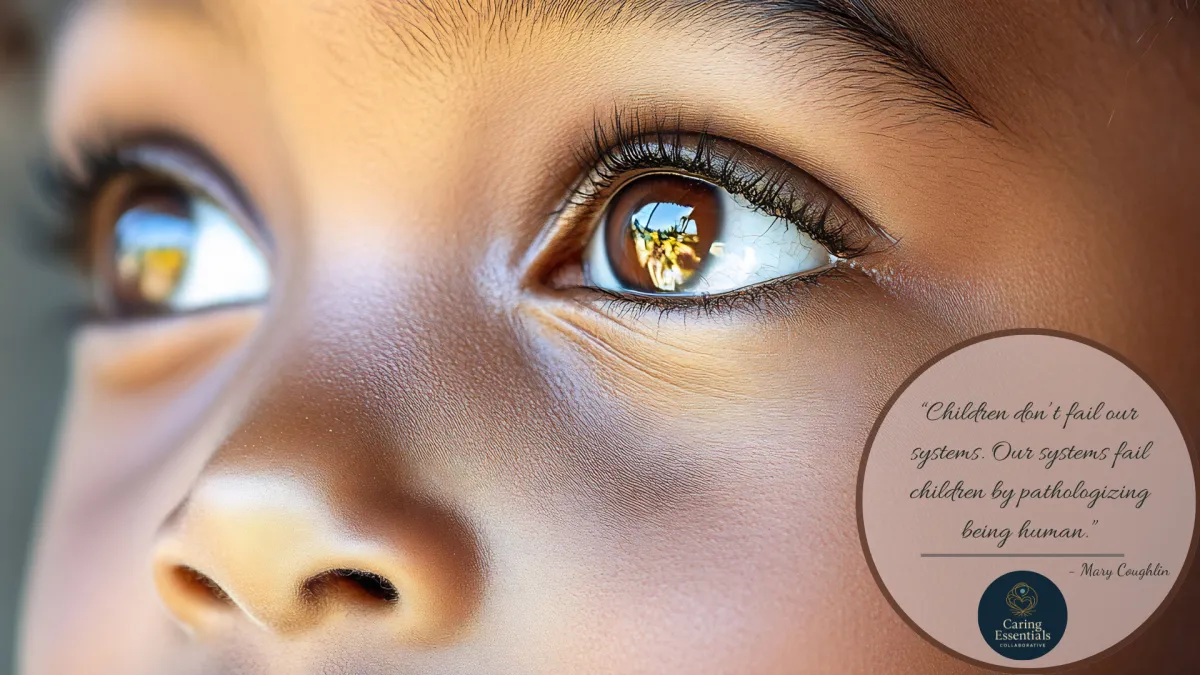
“Children don’t fail our systems. Our systems fail children by pathologizing being human.” - Mary Coughlin
There is a sentence that has been forming in me for a long time.
It finally named itself clearly: We must stop pathologizing being human.
Once you see it, you can’t unsee it.
So much of what we now call “child mental health” is built on an extraordinarily narrow definition of what is considered normal emotionally, behaviorally, culturally, relationally. That narrowness didn’t arise by accident. It was shaped by history, power, fear, convenience, and the understandable but harmful desire to make human complexity more manageable.
But children are not manageable. They are alive.
They are expressive, sensitive, intense, curious, grieving, joyful, overwhelmed, imaginative, defiant, tender, loud, quiet, slow, fast, fluid, rooted, and becoming — often all at once. This is not pathology. It is humanity in motion.
And yet, somewhere along the way, we built systems that began treating this aliveness as a problem.
Big feelings became “dysregulation.”
Difference became “disorder.”
Cultural ways of being became “noncompliance.”
Neurodiversity became “deficit.”
Gender expression became something to correct.
Stress responses became diagnoses.
Instead of asking What happened?
Instead of asking What does this child need?
Instead of asking What is this behavior communicating?
We asked: What’s wrong with you?
That question, asked repeatedly, subtly or explicitly, is where trauma begins.
This isn’t an indictment of parents, teachers, clinicians, or caregivers. Most are doing the very best they can inside systems they did not design and are often powerless to change. Many entered their professions precisely because they care deeply about children.
But caring people can still be required to enforce harmful frameworks.
And frameworks matter.
When a system defines “normal” too narrowly, it doesn’t just misinterpret children who fall outside that band, it manufactures trauma by forcing children to choose between authenticity and belonging. And children, always needing connection for survival, will sacrifice authenticity every time.
They learn to shrink. To mask. To perform. To disconnect from their own inner signals.
Those adaptations may look like “success” in childhood. But they echo loudly in adulthood as anxiety, burnout, perfectionism, numbness, shame, disconnection, and the quiet sense of never quite being at home in oneself.
This is not an individual failing. It is a systemic one. And it affects everyone.
It affects children whose behaviors are misread.
It affects families who are made to feel something is wrong with their child.
It affects educators and clinicians constrained by policies that value compliance over connection.
It affects entire cultures whose ways of being have been marginalized.
It affects adults who are still carrying the cost of having learned, very early, that who they were was “too much” or “not enough.”
So let me be clear and loving at the same time: Children are not broken. Families are not defective. Difference is not disorder.
What is broken is a worldview that mistakes conformity for health and silence for regulation.
This series is not about blame. It is about truth. And truth, when held with care, can be profoundly healing.
Over the coming weeks, I’ll be exploring how we came to pathologize being human across gender, culture, ethnicity, neurodiversity, temperament, and identity and what it might look like to choose a different way forward.
One rooted in:
relational health
nervous-system literacy
cultural humility
belonging
and a much wider, more generous understanding of what it means to be human
This is a call to reimagine child mental health not as a project of fixing children, but as a commitment to building environments, relationships, and systems worthy of them.
If this resonates, I invite you to stay with the series. To reflect. To question. To notice where these ideas touch your own story. Because this isn’t just about children. It’s about the world we are shaping and the humanity we decide to protect.
Until next time,
Mary