Decolonizing Therapy: Early Reflections on Healing, History, and Care
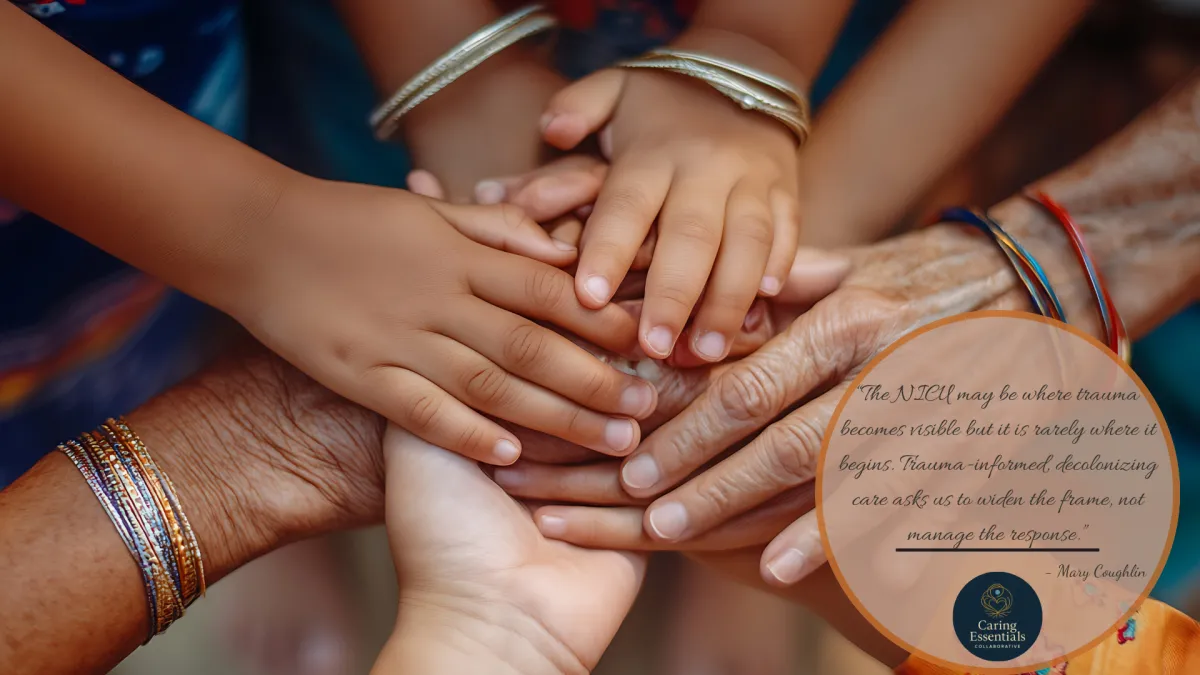
“The NICU may be where trauma becomes visible but it is rarely where it begins. Trauma-informed, decolonizing care asks us to widen the frame, not manage the response.” - Mary Coughlin
Decolonizing Therapy: Early Reflections on Healing, History, and Care
What Does “Decolonizing Therapy” Mean?
Why This Matters So Deeply in the NICU
A Reflection for Clinicians and Caregivers
Caring Science — And the Wisdom Beyond Any One Framework
Why This Matters in the NICU—and Beyond
I just started reading Decolonizing Therapy by Dr. Jennifer Mullan, recommended by a dear friend and longtime advocate who lives at the intersection of healing, justice, and truth-telling.
I’m still early in the book. And already, I find myself pausing often not because the ideas are unfamiliar, but because they are being named so clearly, so unapologetically, and with such moral grounding that they invite deeper reckoning.
These are early reflections, not a summary or critique. What follows is an opening conversation; one that feels especially relevant to those of us working in healthcare, and perhaps nowhere more so than in the NICU.
As I read, I’m reminded that for many families, trauma does not begin at the doors of the NICU, instead it arrives with them, shaped by histories, bodies, and systems long before admission.
What Does “Decolonizing Therapy” Mean?
At its heart, Decolonizing Therapy challenges the assumption that Western psychology—and the systems built around it—are neutral, universal, or benign.
Dr. Jenn (as she refers to herself) invites us to consider how many dominant therapeutic models:
center individualism over relationship
prioritize adaptation to harmful systems rather than transformation of them
pathologize survival responses shaped by oppression, racism, displacement, and historical trauma
Rather than asking, “What’s wrong with you?” decolonizing therapy asks:
What happened to you—and what has been happening to your people?
This shift matters. Because context is not a sidebar to suffering. Context is the story.
Why This Matters So Deeply in the NICU
Those of us rooted in Trauma-Informed Developmental Care (TIDC) know that distress does not emerge in a vacuum and it certainly does not begin at NICU admission.
Families arrive carrying stories that long predate the hospital whether through:
generational and intergenerational trauma
racialized and cultural histories of medical harm, neglect, or exclusion
chronic stress related to poverty, immigration, discrimination, or environmental risk
prior reproductive loss, infertility, or complicated pregnancies
ongoing exposure to systems that have demanded endurance rather than care
The NICU may be the site where trauma becomes visible but it is rarely where it begins.
When we fail to hold this broader context, we risk misunderstanding families’ responses:
grief mistaken for “dysregulation”
vigilance mislabeled as “anxiety”
advocacy interpreted as “difficult behavior”
withdrawal read as disengagement rather than protection
A decolonizing, trauma-informed lens invites us to see these not as 'problems to manage', but as adaptations shaped by history, experience, and survival.
A Reflection for Clinicians and Caregivers
Pause for a moment and consider:
What story might this family be carrying that I cannot see?
What has this parent already survived—before they ever met me?
How might history, culture, or past harm be shaping the way they show up today?
What would it mean to meet this moment with curiosity rather than correction?
Trauma-informed, decolonizing care does not ask us to have all the answers.
It asks us to slow down enough to make room for context.
Caring Science — And the Wisdom Beyond Any One Framework
It also feels important to name that while Caring Science has provided a vital framework within Western healthcare, it does not hold a monopoly on the wisdom of human caring.
Traditions across cultures and continents, Indigenous ways of knowing, Ubuntu, contemplative lineages, liberation-based healing, and ancestral caregiving practices have long understood care as relational, ethical, and collective.
Caring Science is one expression of this truth, not its origin.
Where This Meets B.U.F.F.E.R. and Trauma-Informed Care
As I read Dr. Jenn’s work, I keep seeing resonance not as overlap or ownership, but as shared values.
Decolonizing therapy aligns deeply with the spirit of the B.U.F.F.E.R. framework:
Belonging — honoring identity, culture, and lineage
Understanding — situating behavior within lived and historical context
Forgiveness — releasing shame without bypassing accountability
Frameworks — offering structure that supports rather than constrains
Equanimity — holding complexity without erasing righteous anger or grief
Respect — recognizing families as experts in their own lives
This work does not reject science or structure. It asks us to examine whose knowledge has been centered and whose has been dismissed.
An Invitation to Stay in the Conversation
I’m still reading. Still listening. Still learning.
And perhaps that is exactly the posture this work calls for, not mastery, but humility, courage, and a willingness to see differently.
If you work in healthcare, education, leadership, or caregiving and especially if you work with families whose lives are shaped by systems not of their choosing I invite you to sit with this work.
Let it unsettle you where it needs to.
Let it affirm what you already know in your bones.
And let it widen what you believe is possible in care.
Care is never neutral. And neither is healing.
With care, courage, and deep respect for the many ways humans heal,
Mary
P.S.: If this reflection resonates and you’re longing for a deeper, supported way to embody trauma-informed care in practice, I invite you to explore TIP 2.0 — a guided cohort experience grounded in Trauma-Informed Developmental Care, the B.U.F.F.E.R. framework, and Caring Science. It’s designed not just to build knowledge, but to support becoming — in community, with intention.
→ Learn more about TIP 2.0 here