Can We Be Human Without Nursing? Reclaiming the Nobility of Care
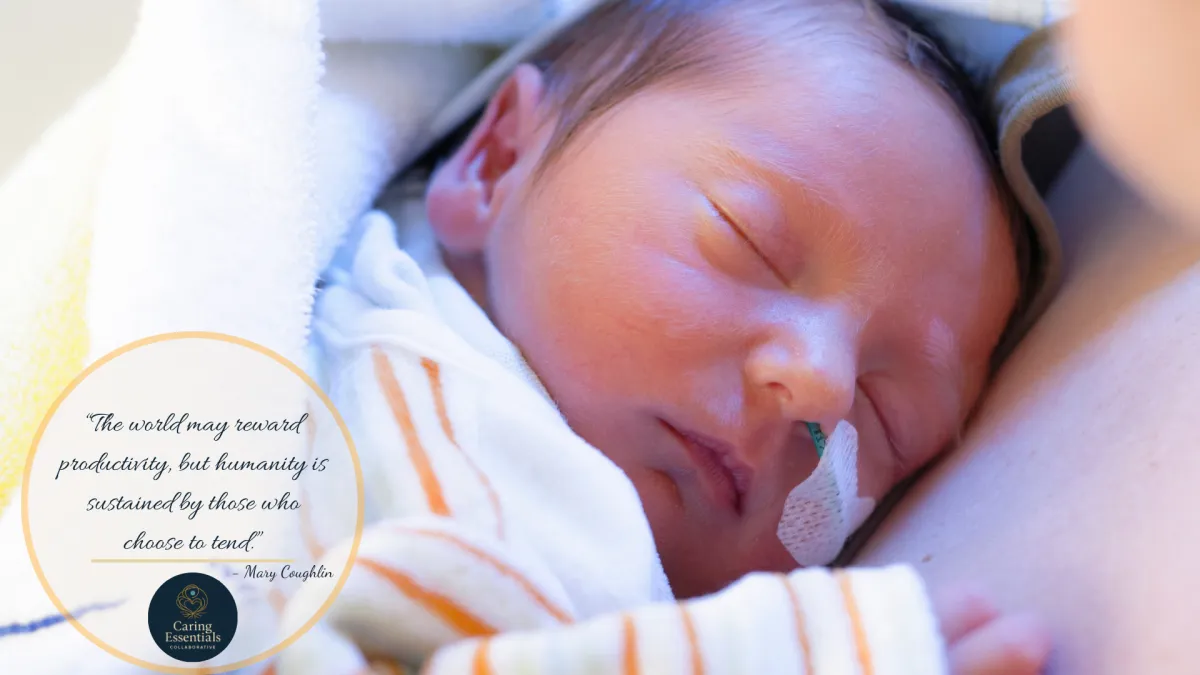
“The world may reward productivity, but humanity is sustained by those who choose to tend.” - Mary Coughlin
The Question That Stopped Me
I was reading a book about nursing when I came across a single sentence that stopped me in my tracks: 'Can we be human without nursing?'
It wasn’t framed as a dramatic statement. It wasn’t bolded or underlined. It was simply there.
But I felt it. Profundity. Awe. And a kind of reckoning. Because that question is not really about a profession. It’s about whether tending vulnerability is optional or foundational.
When we think of nursing, we often think of the licensed role. The hospital. The bedside. The uniform. The scope of practice.
But what if nursing is something far older? What if nursing is the act of protecting fragility? What if it is the instinct to stay when someone is hurting? To regulate when another is overwhelmed? To notice what others overlook? To guard dignity when someone cannot guard their own?
If that is nursing… then we have all been nurses.
We have nursed:
A child with a fever.
A parent through grief.
A colleague through burnout.
A friend through heartbreak.
A patient through fear.
A stranger through crisis.
Even ourselves through seasons of depletion.
And here is what we know biologically: Human beings do not survive without care.
We are born neurologically unfinished. We require years of co-regulation. Our brains wire through relationship. Our capacity for empathy, trust, and moral reasoning develops in the presence of attuned tending. Without sustained care, we do not become fully human.
So when I read that question: 'Can we be human without nursing?' I felt the ground shift. Because in a world increasingly organized around productivity, extraction, speed, and output… tending can begin to look inefficient.
Slowness becomes suspect. Presence becomes indulgent. Relational work becomes invisible. Care becomes a cost center. And yet. Remove tending, and what remains? Technology without protection. Systems without conscience. Productivity without dignity.
If nursing is the act of safeguarding vulnerability, then it is not secondary work. It is civilizational work. And perhaps the more honest question is not whether we can be human without nursing. Perhaps the question is: Where are we choosing to nurse — and where are we choosing to extract?
Because nursing is not a fixed identity. It is a stance. A posture. A spectrum.
We move along it every day. With our families. With our colleagues. With our patients. With our communities. With ourselves.
Sometimes we rush. Sometimes we numb. Sometimes we optimize. Sometimes we stay. Sometimes we protect. Sometimes we advocate.
The question is not whether you are a nurse. The question is: Where are you showing up on the nursing spectrum right now?
And if the nobility of tending has been quietly diminished by the modern world… what might it look like to reclaim it? Not just for licensed nurses. For all of us. Because if tending vulnerability is what makes us human…. then reclaiming it may be one of the most important acts of our time.
Take a moment. When were you last someone’s nurse? And where might you be called to nurse — more intentionally — today?
Take care and care well, Mary