When Survival Gets Diagnosed: Why Behavior Is Not Pathology
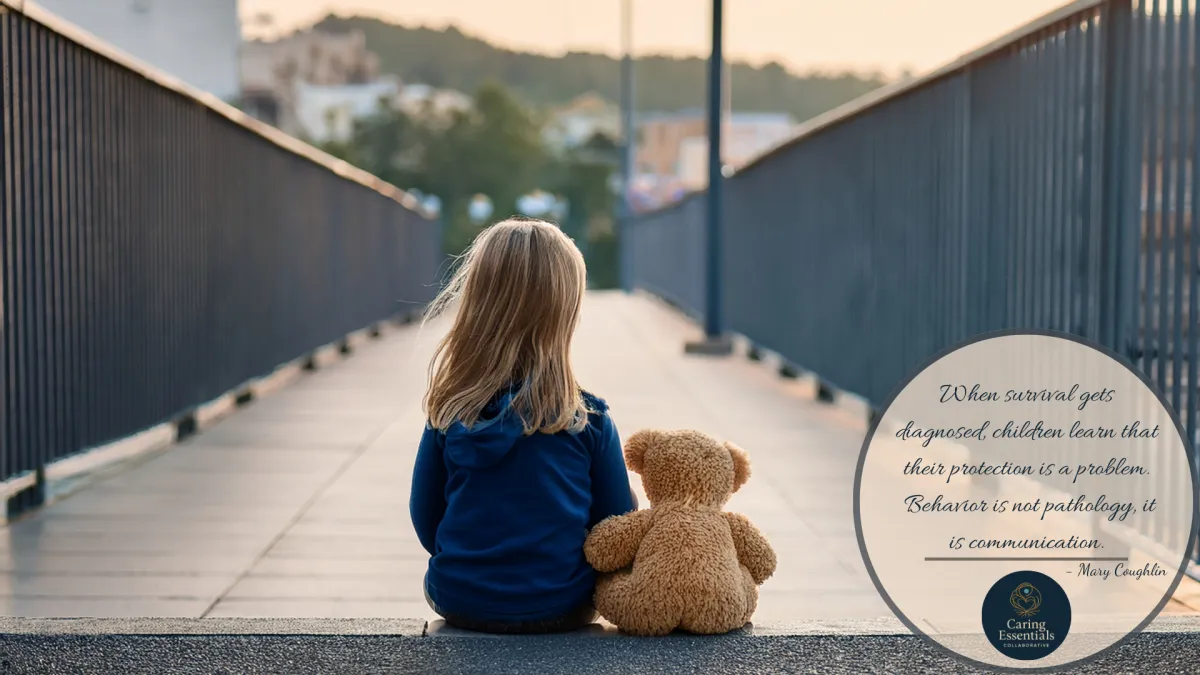
"When survival gets diagnosed, children learn that their protection is a problem. Behavior is not pathology, it is communication." - Mary Coughlin
Post #5 in the "Stop Pathologizing Being Human" Series
A reflection on behavior, trauma, and what we mistake for disorder
One of the most damaging misunderstandings in child mental health is the belief that behavior reveals pathology. In reality, behavior reveals adaptation.
Children do not misbehave in a vacuum. They respond to stress, to overwhelm, to loss, to fear, to misattunement, and to environments that ask more than their nervous systems can give. But when we lack a trauma-informed, relational lens, we interpret these responses as evidence that something is wrong with the child.
This is where survival gets diagnosed.
A child who cannot sit still in a chronically overstimulating environment is labeled inattentive. A child who resists authority after repeated experiences of harm is labeled oppositional. A child who shuts down in the face of overwhelm is labeled withdrawn or depressed. A child who explodes under pressure is labeled dysregulated or aggressive.
What we are often witnessing are nervous systems doing exactly what they are designed to do: protect.
Fight. Flight. Freeze. Fawn. These are not symptoms of disorder. They are signals of stress without adequate support.
Yet instead of asking:
What is this child’s body responding to?
What has happened or is still happening in this child’s world?
What relationships, rhythms, or environments are missing?
We ask:
What diagnosis fits best?
Diagnosis, of course, can be useful. It can open doors to services, accommodations, and understanding. But when diagnosis becomes a substitute for curiosity, it does harm.
It collapses context into category. It individualizes what is often relational or systemic. It treats adaptation as pathology. And children feel this.
They internalize the message that their survival strategies are flaws, that the very things that kept them going are evidence of defect. Over time, this erodes self-trust and replaces it with shame.
The tragedy is not that children struggle. The tragedy is that we respond to struggle by medicalizing it rather than meeting it.
A trauma-informed perspective asks something different. It recognizes that:
Hypervigilance can look like “attention problems”
Withdrawal can be protection
Anger can be grief with nowhere to go
Control can be a response to chaos
Shutdown can be the nervous system’s last line of defense
Seen this way, behavior is not the enemy. It is the messenger. And messengers deserve listening, not punishment, not pathologizing, not silencing.
This doesn’t mean ignoring real distress or abandoning support. It means shifting the center of gravity from What’s wrong with you? to What do you need right now?
It means investing not only in interventions for children, but in:
relational safety
predictable rhythms
culturally attuned care
environments that buffer stress rather than amplify it
adults who understand nervous systems — including their own
When we stop diagnosing survival and start supporting regulation through relationship, children don’t become less accountable. They become more capable. Because healing doesn’t happen when children are told to override their bodies. It happens when their bodies are finally understood.
In the next reflection, I’ll turn toward the adults these children become and how early misinterpretations of behavior echo across a lifetime.
For now, I invite you to consider: What behaviors were you once asked to “fix” that were actually trying to protect you?
Until next time,
Mary