You Can’t Prevent Trauma in the NICU—But You Can Change How It’s Experienced
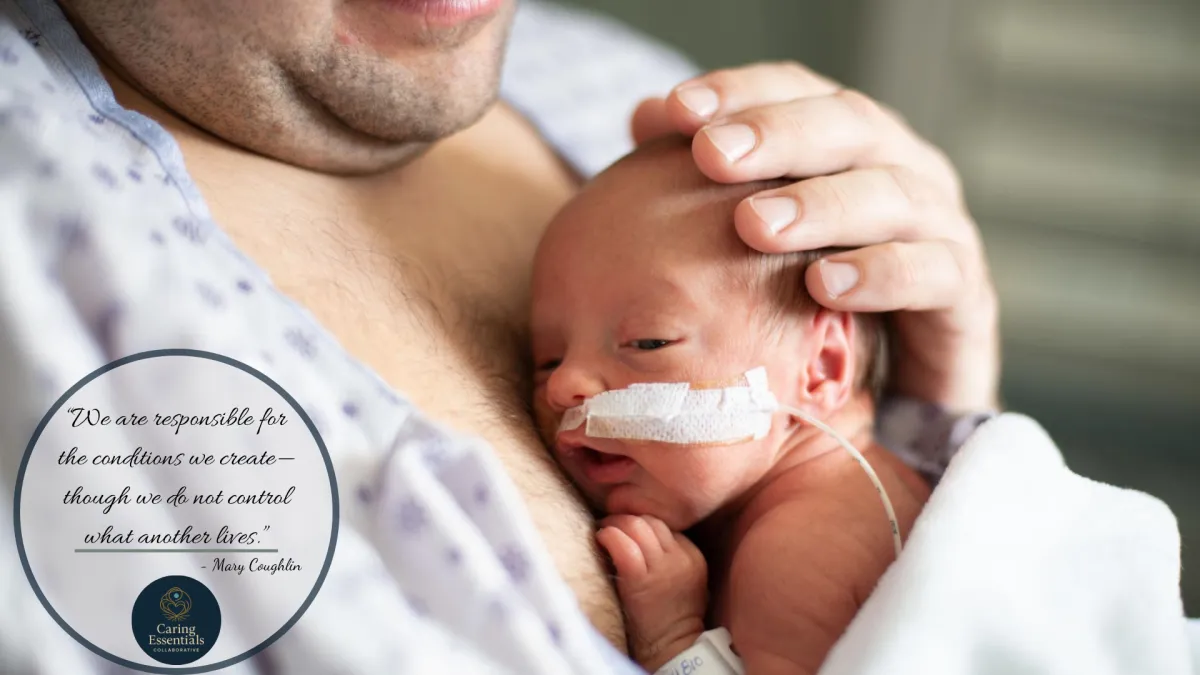
“We are responsible for the conditions we create—though we do not control what another lives.” - Mary Coughlin
You Cannot Prevent Trauma in the NICU
The Assumption Beneath the Aspiration
The Subtle Drift Toward Saviorism
The Edge of Altruism: When Care Becomes About Us
There is a phrase I hear often in our field—spoken with sincerity, hope, and a deep desire to do better: “We can prevent trauma in the NICU.”
And I understand the longing beneath it. Because if we could prevent trauma, we could spare babies and families from pain. We could right what feels unbearable. We could make something inherently uncertain feel safe.
And to be clear—there is real and meaningful work we can do to prevent harm in the NICU. We can:
reduce unnecessary stressors
examine how our practices and environments impact infants and families
make intentional choices that support safety, connection, and regulation
This matters. Deeply. And it is, in many ways, where our greatest opportunity lies.
But the longer I sit with this idea, the more I find myself asking: What are we really saying when we say we can prevent trauma? And perhaps more importantly—How might we expand what we mean by prevention?
The Assumption Beneath the Aspiration
To believe we can prevent trauma can suggest that trauma is:
clearly defined
universally experienced
and fully within our control
But trauma is more complex than that. Trauma is not simply what happens. It is how what happens is experienced, processed, and carried.
It is shaped by:
the nervous system
past experiences (long before the NICU)
meaning-making
and relationship
Two families can walk through the same clinical course and carry entirely different imprints of that experience.
So perhaps the invitation is not to move away from prevention—but to recognize that it is only one part of a much larger landscape.
Expanding What We Mean by Prevention
What if prevention is not about eliminating all possibility of trauma…but about recognizing the breadth of opportunity we hold?
The opportunity:
to prevent what is preventable
to mitigate what cannot be avoided
and to support how experiences are held, understood, and integrated
When we see prevention this way, it becomes less about control—and more about careful, conscious participation in the experience unfolding around us.
The Subtle Drift Toward Saviorism
This is where something more subtle—and deeply human—emerges. The desire to prevent trauma often begins as care…but it can slowly drift into something else.
A quiet belief that:
if we do enough
if we get it right
if we apply the right model
we can fix what is inherently complex and relational.
This is not about fault. It is not about intention. It is a very human drift—one that many of us, at times, have felt in ourselves. And here is where the shift happens—almost imperceptibly.
The focus moves: From the infant and family navigating their lived experience To us—as the ones who helped, who improved things, who made a difference
And in that shift, we risk becoming the center of the story…instead of honoring the truth that we are part of it, not the whole of it.
The Edge of Altruism: When Care Becomes About Us
Joan Halifax speaks about what she calls edge states—those places where our most oble qualities begin to tip into something else.
Where:
altruism can become self-serving
empathy can become overwhelm
integrity can become rigidity
respect can become distance
engagement can become overextension
Because each of these qualities has an edge.
On one side, there is genuine care:
the desire to alleviate suffering
the willingness to show up
the commitment to serve
But if we are not attentive, these same qualities can slowly shift from being with others in their experience to needing to feel effective, helpful, or good because of it
The care is still there. The intention is still good. But something else has entered the space—a subtle internal orientation toward ourselves. And this is where the drift can become almost invisible.
The Reality of the NICU Experience
The NICU is not a neutral environment. It is a place of:
urgency
uncertainty
separation
invasive intervention
and profound emotional intensity
Even in the most compassionate, developmentally supportive units, there are elements that cannot be removed: a premature birth, a critical diagnosis, the loss of imagined futures.
These are not failures of care. They are realities of the human experience. Which means: Some degree of stress, overwhelm, and potential trauma may be unavoidable.
And that truth is not a limitation of our care. It is an invitation to deepen it.
A Trauma-Informed Reframe
Perhaps the goal is not to prevent trauma entirely…but to take responsibility for what is ours.
We are responsible for the conditions we create—but we do not control what another lives.
And within that truth lies both our opportunity and our responsibility. We are called to examine:
the practices that add unnecessary burden
the policies that create distance or disempowerment
the attitudes that shape how care is experienced
And at the same time, to honor that each person’s experience is shaped by a complexity that extends far beyond us.
From Control to Relationship
Trauma-informed care is not built on control. It is built on relationship. It asks us to:
stay present rather than fix
witness rather than define
support rather than solve
It invites a different kind of question:
Not How do we prevent trauma? But How are we shaping the experience that is unfolding? And How can we be with others in a way that supports safety, connection, and meaning?
The Opportunity Within the Work
There is profound opportunity in this work. In the smallest moments:
a pause before a procedure
an invitation for a parent to participate
a shift in language
a reconsideration of routine
These are not small things. They are the places where prevention, mitigation, and healing quietly live.
Closing Reflection
Perhaps the work is not to prevent trauma entirely. Perhaps the work is to ensure that within even the hardest moments:
there is connection
there is dignity
there is meaning
and there is someone who stays
Because trauma is not only shaped by what happens. It is shaped by whether we were alone in it.
Invitation
As you reflect on your own practice, consider:
Where do we have opportunities to prevent harm that we may be overlooking?
How are we participating in the conditions that shape experience?
What does it mean to offer care that is both responsible and humble?
Take care and care well,
Mary