When Peace Becomes the Answer: Reflections on Grief, Letting Go, and Trust
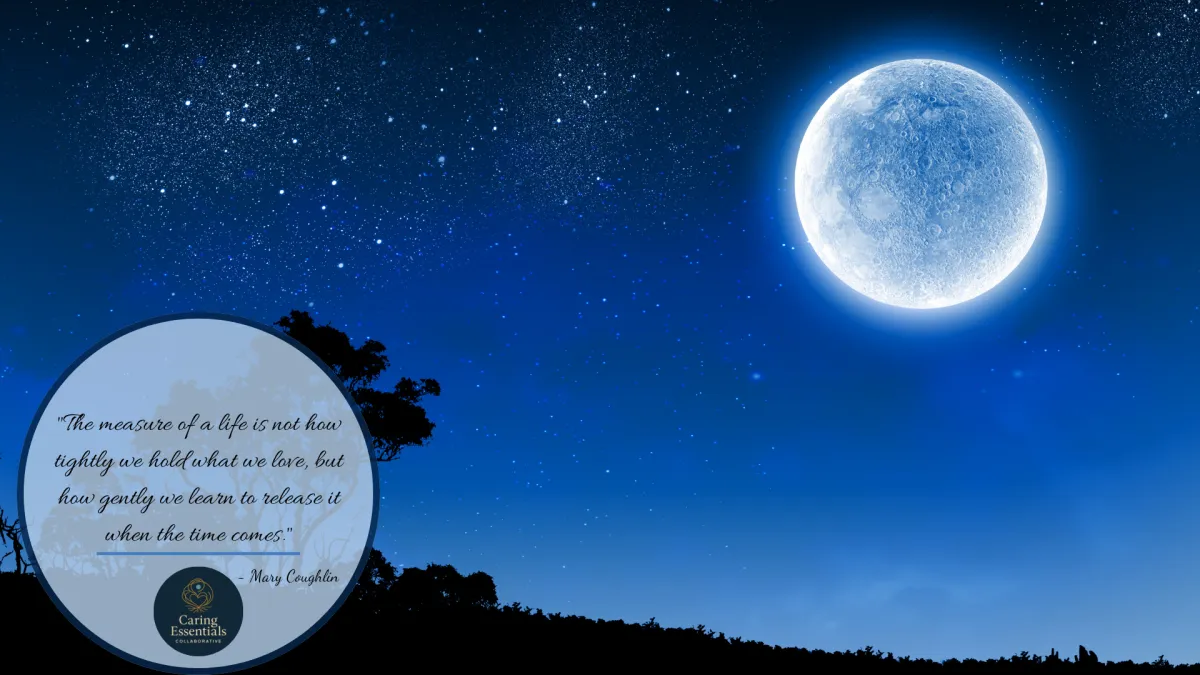
"The measure of a life is not how tightly we hold what we love, but how gently we learn to release it when the time comes." - Mary Coughlin
Author's Note - I wrote the reflection below under the light of May's Blue Moon. At the time, my beloved dog George was gravely ill, and my sister-in-law, Annmarie, was preparing to enter hospice care. Within days of writing these words, both George and Annmarie died. I considered revising the piece completely, but ultimately decided to leave it largely as it was written. It captures a moment in time when I was standing between hope and surrender, love and loss, certainty and mystery. Reading it now, I am reminded that grief does not invalidate our prayers. Sometimes the answer arrives in a form we did not anticipate. Sometimes peace becomes the healing. I share these reflections in honor of George and Annmarie, with gratitude for the love they brought into our lives and for the lessons they continue to teach me. —Mary
The full moon arrived this month carrying more weight than usual. Perhaps that's what Blue Moons do. They illuminate things we have been trying to hold and things we have been trying to release.
This year, my moonlit reflections began with two beloved companions.
George, our Newfoundland-Saint Bernard mix, is not doing well. At nearly eleven years old, his body is telling a story that none of us want to hear. My wish for him is simple: recovery if recovery is possible. And if it is not, then a peaceful, gentle passing surrounded by love.
My friend Annmarie enters hospice this week. She has been a blessing in my life, one of those people whose presence leaves the world softer and kinder than it was before. Saying goodbye feels impossible, even while knowing it is inevitable.
As I sat with these wishes, I realized they were not really wishes at all. They were acts of surrender. Not giving up. Not resignation. Simply acknowledging that love does not always get to choose the outcome. Sometimes love means hoping for healing. Sometimes love means hoping for peace. And sometimes love means holding both at the same time.
As the moon rose higher, my attention turned inward.
I found myself thinking about the future.
My husband, bless him, continues to send me an endless stream of real estate listings and videos. Every few hours another possibility appears in my inbox. A cottage. A farmhouse. A house near the water. A place in another state. A future I haven't yet decided I want.
I realized how much energy I have been spending trying to figure out what comes next. Where should we live? What should I build? What is my next chapter supposed to be?
The truth is, I don't know. And perhaps for the first time, I am beginning to wonder whether I need to know.
Maybe this season is less about finding answers and more about becoming available to them. Maybe uncertainty is not a problem to solve but a space to inhabit.
Then came the hardest reflection of all. The one I almost didn't write. The one about ego.
For years, I have devoted myself to trauma-informed developmental care. I have studied it, taught it, written about it, advocated for it, and woven it into nearly everything I do.
Lately, I have noticed something uncomfortable arising within me when I see others presenting similar ideas through their own lens and gaining attention. It's not something that is ever present, but subtle, hanging very quietly in the background that, although I wish it would go away, I can no longer ignore it.
It feels like a fusion of frustration, fear, protectiveness, and maybe a sprinkle of jealousy. The irony is I genuinely want more people talking about trauma-informed developmental care. I want nurses, physicians, psychologists, therapists, educators, parents, and leaders to extend these ideas into the world. I want the movement to grow.
And yet sometimes a small voice inside me whispers: "What about your work?"
It is not a voice I am particularly proud of. But it is an honest one. And honesty, I've learned, is usually where healing begins.
As I sat with that discomfort (and the knowing I have more years behind my than in front of me) I found myself thinking of Baskin-Robbins and their thirty-one flavors.
Imagine if there were only one flavor of ice cream. Some people would love it. Many wouldn't. Most would simply walk away.
But when there are thirty-one flavors, more people find something that speaks to them.
The same is true of ideas. Some people connect with science, others connect with story. Some connect with data, while others connect with poetry. Some learn through research papers; others learn through lived experience.
If trauma-informed developmental care is going to reach the world, it cannot belong to any one person. It must belong to all of us.
People will encounter it through different teachers, different frameworks, different languages, and different perspectives. And that is not evidence that the work is being diluted. It may actually be evidence that the work is alive.
The deeper truth is that I was never meant to be the sole steward of these ideas. None of us are. We plant seeds. Others water them. Still others carry them to places we may never visit.
The garden grows because it no longer depends on a single gardener.
And this is what I take from George and Annmarie's journeys. Each of us carries something that has never existed before and will never exist again — a unique expression of love, wisdom, creativity, and presence shaped by the particular contours of our lives. We all leave traces of ourselves in the hearts, stories, and lives of others. The measure of a life is not found in how tightly we hold on, but in how generously we share what we have been given.
Perhaps that is the invitation of this Blue Moon. To loosen the grip. To trust what has been planted. To love without controlling outcomes. To grieve without losing gratitude. To release certainty without losing direction. To celebrate the many voices carrying forward what matters most. And to remember that what is meant for us will not pass us by.
Not the people. Not the opportunities. Not the future. Not even the work.
The moon will wane. George's story will unfold. Annmarie's journey will continue beyond my sight. The future will arrive in its own time. And somewhere, someone will discover a flavor of ice cream that helps them understand what it means to heal.
That is enough.
More than enough.
It is, perhaps, exactly as it should be.
Hugs and hope for a better world, Mary