When Children Learn to Shrink to Belong: Gender, Culture, and Trauma
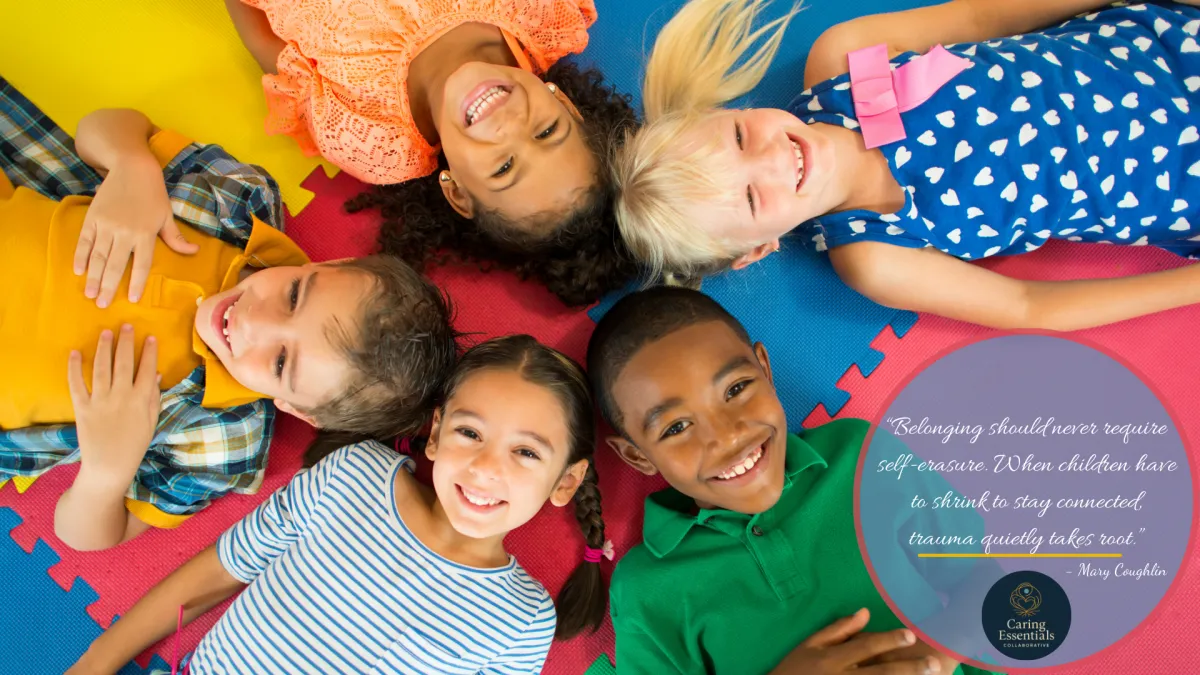
“Belonging should never require self-erasure. When children have to shrink to stay connected, trauma quietly takes root.” - Mary Coughlin
Part 3 in the 'Stop Pathologizing Being Human' Series
A Mary’s Musings reflection on gender, culture, and the quiet erasure of self
There is a moment — sometimes visible, often silent — when a child learns that belonging has conditions.
It happens when a boy is told not to cry. When a girl is praised for being “good” instead of being honest. When a child’s cultural ways of speaking, moving, or expressing emotion are corrected rather than understood. When a Black or Brown child is disciplined for behaviors that would be overlooked in others. When a gender-expansive child senses that their authenticity makes adults uncomfortable.
It happens when the message lands — subtly or overtly: Be less of who you are if you want to stay connected.
Children do not arrive in the world wanting to disappear. They arrive expressive, embodied, relational, alive. But they are exquisitely attuned to power. They know long before they can name it what is welcomed and what is merely tolerated.
And so they adapt.
They soften their voices. They quiet their bodies. They suppress questions. They translate themselves.
They monitor their tone. They learn which emotions are safe and which are not.
This is not maturity. It is survival.
Gender, culture, and race are not incidental here, they are central.
Children whose identities fall outside dominant norms are far more likely to receive the message that their way of being is too much, not enough, or wrong. Their behaviors are more likely to be interpreted as defiant, inappropriate, or threatening rather than developmentally meaningful or contextually adaptive.
This is not about intent. It is about impact.
A system can be well-intentioned and still deeply harmful when it lacks cultural humility, relational depth, and awareness of its own biases.
What makes this especially painful is that the very behaviors children use to survive — compliance, masking, perfectionism, emotional containment — are often rewarded.
They look like success. But inside, something essential is being traded away. Because when children repeatedly choose belonging over authenticity, they don’t just lose behaviors. They lose self-trust. They learn to doubt their inner signals. They disconnect from their bodies. They outsource worth to external approval. They become skilled at reading rooms and become strangers to themselves.
This is the quiet trauma of erasure.
It does not always announce itself with crisis. Often it shows up later in anxiety, depression, burnout, shame, people-pleasing, rage turned inward, or the persistent sense of being unseen even in connection.
And it doesn’t only affect those who are marginalized.
Children raised inside rigid gender roles also lose parts of themselves. Boys lose tenderness. Girls lose fire. Everyone loses range.
A system that demands shrinking harms everyone — even those it claims to center.
What if we named this clearly? What if we said: The problem is not that children are too sensitive, too expressive, too different, too slow, too fast, too much. The problem is that our systems are not spacious enough to hold the full range of humanity.
Belonging should never require self-erasure (and in fact, I will argue that that is not belonging at all, but fitting-in).
True belonging — the kind that supports mental health, resilience, and integrity — allows children to remain intact while they grow. It makes room for difference. It responds with curiosity rather than correction. It understands that behavior is shaped by culture, context, nervous systems, and history — not moral failure.
When we stop asking children to shrink, something remarkable happens. They don’t become chaotic.
They become anchored. They develop regulation through relationship. They learn boundaries without shame. They grow confidence without arrogance. They carry their identities with dignity instead of fear.
This is not permissiveness. It is attunement.
In the next reflection, I’ll turn toward neurodiversity and the hidden cost of camouflage — and what happens when children are praised for passing rather than supported in being.
For now, I invite you to sit with this: Where did you learn to shrink in order to belong — and what would it mean to reclaim that lost space in yourself?
Until next time,
Mary