The Cost of Performance: Reclaiming Presence in a World That Cannot Sit With Pain
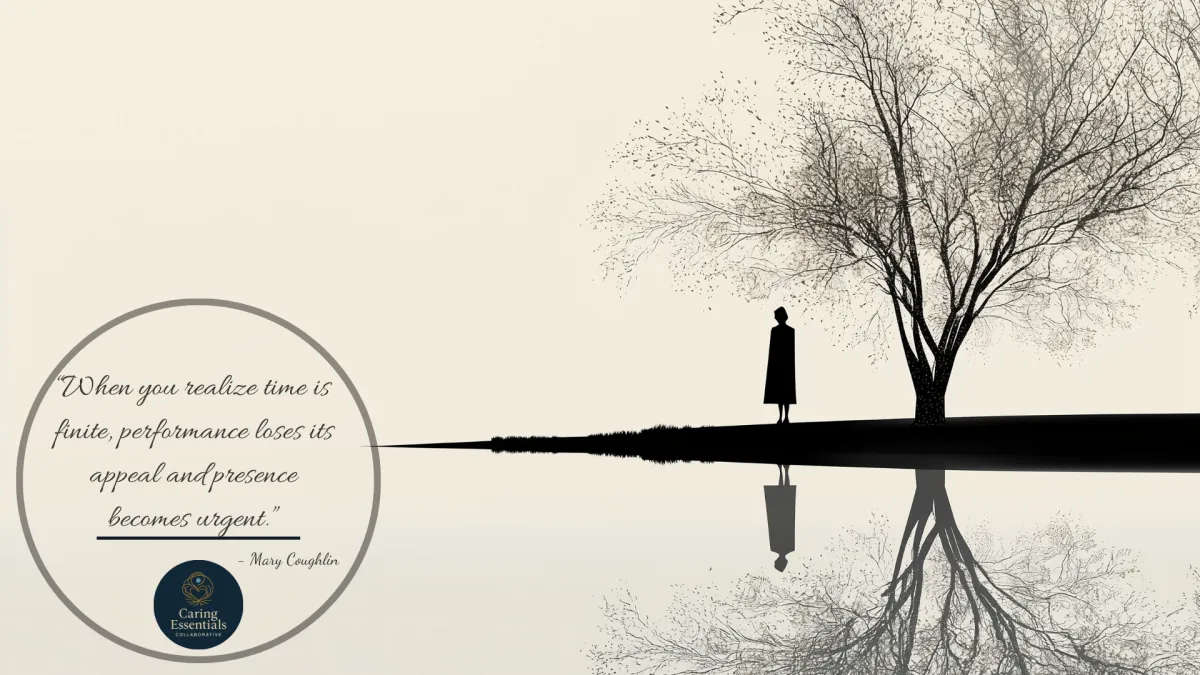
“When you realize time is finite, performance loses its appeal and presence becomes urgent.” - Mary Coughlin
We live in a world that rewards performance but has little tolerance for presence or pain. From an early age, many of us learn that what matters most is how we appear, how well we function, how quickly we recover, and how comfortably we make others feel. “Fake it till you make it” becomes more than advice; it becomes a way of surviving. Smile through the ache. Keep moving. Don’t slow the room down with your truth.
I’ve lived inside that message for a long time. And beneath all that striving, I’ve come to recognize a quiet, persistent emptiness.
Ours is a culture that struggles to sit with suffering. Rather than tending pain, we manage it. Rather than listening, we distract. Rather than staying, we escape. Pain is not welcomed as a signal of unmet need or relational rupture, it is treated as something to be hidden, overcome, or numbed. When pain cannot be eliminated, it is often exploited: turned into content, productivity, spectacle, or proof of resilience.
This is how presence gets replaced with performance.
We are subtly taught that goodness looks like compliance, that worth is conditional, and that taking up too much space, emotionally, physically, spiritually, is dangerous. We learn to be palatable. To soften our edges. To carry our grief quietly. To make ourselves useful rather than whole.
Over time, this costs us. Because emptiness is not a lack of stimulation. It is a lack of attuned presence.
I know how tempting it is to fill that emptiness the only ways we’ve been shown how: by buying, consuming, achieving, scrolling, staying busy. I’ve done it myself. We lose ourselves in noise and distraction, hoping something will finally soothe the ache we cannot quite name. But distraction does not heal emptiness; it only delays it. The nervous system remains hungry. The soul remains unheard.
This is not a personal failure. It is a collective wound.
Our systems—educational, economic, social, even healthcare—are built to prioritize output over interior life. Children quickly learn that what is rewarded is performance: grades, behavior, achievement, likability. Curiosity, embodiment, emotional truth, and rest are treated as secondary and sometimes even as liabilities. Even when we do not consciously teach this, the culture does. And so the wound is carried forward, often invisibly, across generations.
Eventually, the strain shows.
There are moments when the performance collapses, when something breaks through despite our best efforts to contain it. An outburst. A rupture. Tears that surprise us. Words we didn’t plan to say. I used to see these moments only as failures of regulation, evidence that I should have done better, known better, held it together longer.
But I’ve learned that sometimes, in the aftermath, if we choose to stay rather than retreat, something else becomes possible.
If we slow down enough, we can look at what spilled out. Not with shame, but with curiosity. We can begin to trace it back, not just to the trigger, but to the ache underneath. The older pain. The unmet longing. The places where we learned to swallow ourselves in order to survive. Sometimes we can even touch it, not intellectually, but somatically, feeling it in the chest, the throat, the gut. Tender. Exposed. Alive.
This is the work no one really prepares us for (or at least I've never felt prepared for).
Because metabolizing pain is not just about understanding it. It is about staying present long enough for the body and the heart to release what they have been carrying: grief, anger, betrayal, loneliness. And eventually, sometimes, it asks something even harder: forgiveness. Not the bypassing kind. But the slow, embodied kind that loosens the grip of what hurt us without excusing it or erasing its impact.
This work can be profoundly lonely.
Especially when the people around us are still lost in the game, still performing, distracting, numbing, chasing the next thing. When you are doing the quiet, invisible labor of integration while the world rushes past, it can feel like living on a different frequency altogether. There is no applause for this kind of courage. No clear milestones. No shared language.
Sometimes the solitude feels spacious, manageable, even sacred. And sometimes it compounds the pain. Loneliness layered on top of the original wound. Loneliness born not of isolation, but of asymmetry, of seeing what others cannot or will not yet see. Of refusing to go back to sleep once you have awakened to your own interior life.
And then, for many of us, something else shifts.
There comes a moment when we realize we have more time behind us than we do in front of us. I felt this shift before I had words for it. This awareness can stir regret, yes. Grief for moments missed, years spent performing, energy given to games that never truly fed us. But it can also awaken something else entirely: urgency.
Not the frantic urgency of productivity. But the clarifying urgency of truth.
A growing unwillingness to waste what remains playing a role that no longer fits. A deeper pull to return to moments that are waiting to be cherished, savored, and fully inhabited. Moments of presence that may not be grand or visible, but are real, honest, and alive.
There is a quiet longing, too, to let those moments matter beyond us, to allow them to be sustained in the memories of others. Not as accomplishments, but as ways of being. As evidence that we were here. That we loved. That we stayed.
This is not about legacy as achievement. It is about legacy as presence remembered.
Healing, then, is not a linear ascent toward wholeness. It is a spiral that brings us back to the same places again and again, each time with slightly more capacity, slightly more tenderness. Some days we can hold it. Other days we need to be held and find no arms readily available.
This, too, deserves compassion. Because choosing presence in a world that rewards disconnection is not just brave, it is freakin exhausting. And the loneliness that accompanies it is not a sign of failure; it is often the cost of refusing to abandon yourself again.
Perhaps the deeper work of this season of life, this moment in herstory (😉), is not to move faster toward a promised future, but to slow down enough to inhabit the present with honesty and care. To tell the truth about the cost of performance. To notice where we learned to disappear. And to choose together, again and again to remain.
Not someday. Not when we arrive. But here, now, in the moments that are still waiting.
Staying with what matters,
Mary