Re-Membering Our Humanity: Have We Lost the Plot?
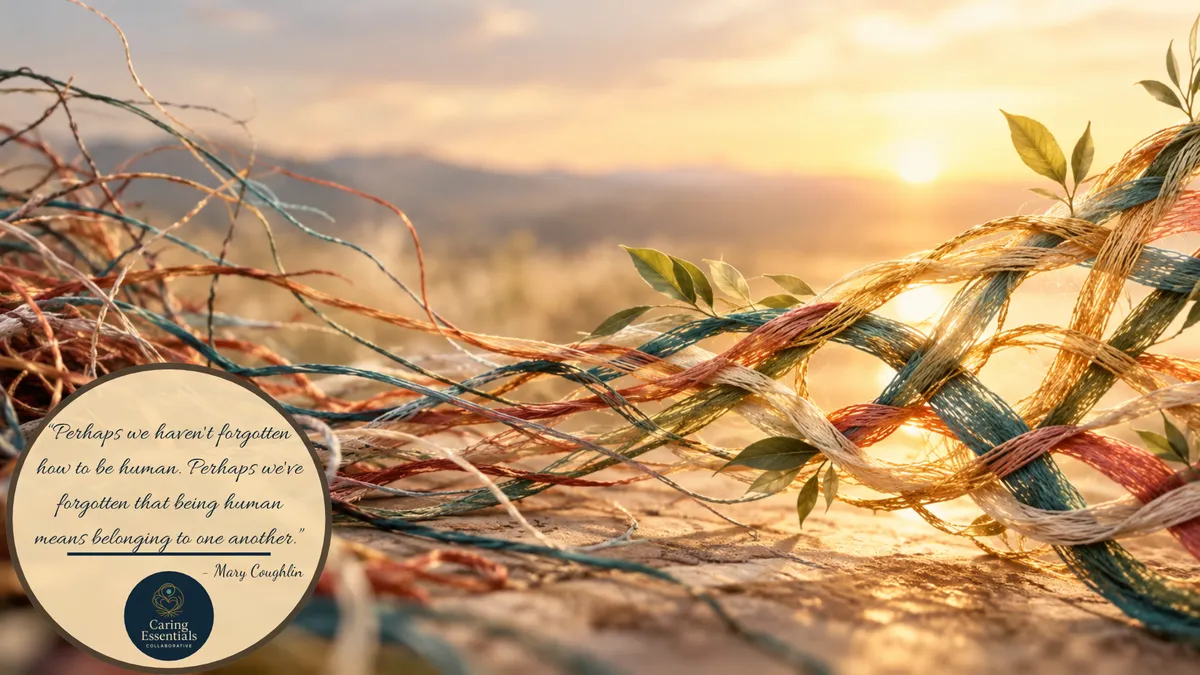
“Perhaps we haven't forgotten how to be human. Perhaps we've forgotten that being human means belonging to one another.” - Mary Coughlin
Perhaps the work before us is not to become something new, but to remember—and re-member—who we have always been.
I've been sitting with a thought that emerged while reading Jan Phillips' Stop Seeking, Start Finding. She references a line attributed to John Updike:
“Chaos is just a local view of things working out in general.”
I stopped reading.
Not because I found the words particularly comforting, but because they stirred something I've been wrestling with for quite some time.
Look around.
There is so much cruelty, corruption, division, and disregard for human dignity. Not just here in the United States, but across much of the world. We seem increasingly willing to sacrifice one another's wellbeing in pursuit of power, profit, security, or some elusive promise of more.
And I find myself wondering whether humanity has simply lost the plot.
Somewhere along the way, we became mesmerized by the shiny objects of modern life. Wealth. Status. Productivity. Consumption. Growth. We built an altar around accumulation and, in many ways, made an economic system our religion.
I'm not suggesting that commerce, innovation, or prosperity are inherently harmful. They can contribute enormously to human flourishing. But when profit becomes more important than people, when growth becomes an end in itself, and when human worth is measured by productivity or purchasing power, something essential gets lost.
We begin organizing our lives around the very things that were supposed to serve them.
And perhaps most troubling, we construct systems that reinforce these priorities until they become so familiar that we stop questioning them.
We normalize competition over cooperation. Efficiency over presence. Individual achievement over collective wellbeing. Extraction over stewardship.
Then we wonder why we feel so disconnected.
What if the chaos is revealing something?
I don't believe suffering is necessary for enlightenment. Nor do I believe cruelty is somehow justified because it might eventually awaken us.
But I do wonder whether the extraordinary dysfunction we're witnessing is making visible something we have been unwilling, or unable, to see.
Perhaps the systems we've created are showing us precisely what they are designed to produce.
When we reward accumulation without accountability, power without stewardship, and productivity without regard for human wellbeing, why should we be surprised when exploitation, disconnection, and indifference follow?
Human beings are capable of extraordinary cruelty. History makes that painfully clear.
But we are also capable of extraordinary tenderness, generosity, courage, cooperation, and love.
So perhaps the question isn't whether humanity is fundamentally good or bad.
Perhaps the more consequential question is:
What conditions are we creating, and which parts of our humanity do those conditions call forth?
This is a question that has shaped much of my professional life.
In healthcare, I've witnessed how systems organized around efficiency, hierarchy, and measurable outcomes can unintentionally diminish the very humanity they are intended to serve.
I've also witnessed what becomes possible when people feel safe, respected, connected, and valued. When caring is not simply an individual virtue but an organizing principle.
And I increasingly wonder why we don't ask these same questions of our economies, governments, communities, and institutions.
What might become possible if human flourishing, rather than perpetual accumulation, became our measure of success?
Remembering, or perhaps re-membering
As I continued reflecting, I found myself returning to another idea, one I encountered years ago in Neale Donald Walsch's Conversations with God.
Re-membering.
Not simply remembering something we've forgotten, but re-membering ourselves. Becoming members again. Restoring our awareness of belonging to something larger than our individual lives.
I find that distinction profoundly moving because perhaps we haven't simply forgotten how to care. Perhaps we've dis-membered ourselves.
We've separated humanity from nature. Mind from body. Work from meaning. Economics from ethics. Individual success from collective wellbeing.
We've created artificial boundaries around things that are inherently and profoundly interconnected and we've come to regard those separations as natural. Yet our very existence tells another story.
We enter this world utterly dependent upon relationship. Our earliest experiences of safety, connection, and belonging shape how we come to know ourselves and others.
We flourish through connection.
We survive through cooperation.
We become ourselves in relationship.
And none of that stops being true when we grow up.
Perhaps the deepest illusion we've embraced is that we are separate, self-sufficient beings whose wellbeing can somehow be detached from the wellbeing of others.
What if re-membering means recognizing that your humanity and mine are not competing interests?
What if the suffering of another is not simply their problem?
What if belonging is not something to be earned, but something inherent in being alive?
And what if our institutions were organized around that understanding?
An invitation toward mystery
I've also found myself drawn toward mysticism. Not toward certainty, or the pursuit of some extraordinary spiritual experience, but toward a deeper exploration of oneness, interconnectedness, and the mystery of existence.
At this stage of my life, that curiosity feels unexpectedly warm.
Perhaps it is the natural evolution of years spent studying human development, caring, trauma, relationships, and the conditions that allow people to flourish. Or perhaps it is simply a growing willingness to stop trying to explain everything and begin experiencing more of it.
I don't know and I'm discovering that not knowing can be a rather beautiful place to stand (albeit a little uncomfortable).
What interests me about the mystical traditions is their invitation to move beyond the illusion of separateness. To experience ourselves not as isolated individuals navigating an indifferent world, but as participants in a much larger, interconnected whole.
I don't pretend to understand what that means in its fullness, but I am curious. And I wonder whether the work of re-membering our humanity might begin with something as simple, and as radical, as learning to experience one another differently.
Not as competitors.
Not as categories.
Not as strangers whose lives have little bearing on our own.
But as fellow members of this extraordinary, complicated, vulnerable human family.
Perhaps we haven't lost the plot entirely
I return to Updike's words with a little more curiosity now. Perhaps chaos isn't necessarily evidence that everything is working out. Perhaps it is sometimes evidence that something is no longer working—and can no longer conceal its contradictions.
That doesn't guarantee transformation.
History reminds us that fear and uncertainty can lead us toward greater compassion or deeper division. There is nothing inevitable about progress; but recognition creates possibility, and possibility invites responsibility.
Perhaps we are being invited to question the stories we've inherited, the systems we've normalized, and the values we've allowed to shape our lives.
Perhaps the task isn't to recover some imagined golden age of humanity.
Perhaps it is to become more intentional about the future we are creating.
To stop treating kindness as a personal luxury and begin understanding it as a social necessity.
To stop imagining compassion as something separate from leadership, economics, or public policy.
To stop treating belonging as a sentimental aspiration and begin recognizing it as a condition for human flourishing.
And perhaps, most importantly, to recognize that we do not have to wait for the entire world to change before we begin living differently.
We can practice another way of being in our homes, workplaces, communities, and relationships.
We can question what we reward.
We can notice whom our systems exclude.
We can resist the temptation to reduce people to labels, productivity, or perceived worth.
We can build conditions that make caring possible.
And we can remain curious about the mystery of belonging to something far greater than ourselves.
I don't know whether the universe is working everything out. But I do believe we have a part in what happens next. And perhaps the work before us is not simply to remember our humanity.
It is to re-member it.
To restore ourselves to one another.
To recognize that none of us flourishes alone.
And to begin building a world that reflects that truth.
Maybe that was the plot all along.
With curiosity, courage, and a commitment to re-membering,
Mary
An invitation to reflect
Where in your own life have you noticed the tension between the values you hold and the systems in which you live or work?
And what might change if we began organizing our lives and our institutions around the understanding that we belong to one another?